प्लीओट्रोपिज्म (Pleiotropism):-
· Gr. – pleio = many (अनेक)
tropic = effects (प्रभाव)
· परिभाषा (Definition):- जब एक जीन एक से अधिक आनुवंशिक लक्षणों को नियंत्रित करता है तो इस प्रक्रिया को Pleiotropism कहते हैं।
(When a single gene controls more than one genetic traits, then this is called Pleiotropism. Such a gene is called as pleiotropic gene.)
· उदाहरण (Example):- Sickle Cell Anemia Disease (Autosomal recessive disorder)

Segmental Polyploidy (खंडीय बहुगुणन):- It is a type of polyploidy in which the chromosome sets are partly homologous and partly non-homologous. In simple words, the genomes involved are neither completely identical (autopolyploidy) nor completely different (allopolyploidy)—they overlap in segments.
[यह बहुगुणन का एक प्रकार है जिसमें गुणसूत्र समूह आंशिक रूप से समरूप और आंशिक रूप से विषमरूप होते हैं। सरल शब्दों में, इसमें शामिल जीनोम न तो पूरी तरह से एक जैसे (स्व-बहुगुणन) होते हैं और न ही पूरी तरह से भिन्न (भिन्न-बहुगुणन)—वे खंडों में एक दूसरे को ओवरलैप करते हैं।]
Key Features (मुख्य विशेषताएं):-
> Chromosome sets show partial homology
(गुणसूत्र समूह आंशिक समरूपता दर्शाते हैं)
> During meiosis, bivalents and multivalents may both form
(अर्धसूत्री विभाजन के दौरान, द्विसंयोजक और बहुसंयोजक दोनों बन सकते हैं)
> Shows intermediate behavior between auto- and allopolyploids
(स्व-बहुगुणन और विभिन्न-बहुगुणन के बीच मध्यवर्ती व्यवहार दर्शाता है)
> Often results from hybridization between closely related species
(अक्सर निकट संबंधी प्रजातियों के बीच संकरण के परिणामस्वरूप होता है)
Classic Example (क्लासिक उदाहरण):- Wheat (Triticum aestivum) [गेहूं (ट्रिटिकम एस्टाइवम)]
Hexaploid (षट्कोणीय बहुगुणन):- 2n = 6x = 42
Genome constitution (जीनोम संरचना):- AABBDD
> Genomes A, B, and D are similar but not identical → segmental homology
(जीनोम A, B और D समान हैं लेकिन एक जैसे नहीं → खंडीय समरूपता)
.png)
शुद्ध वंशक्रम (Pure line):- किसी स्वपरागित जाति के एक पूर्णतया समयुग्मनज पौधे की सन्ततियों को शुद्ध वंशक्रम कहते हैं।
(The offspring of a completely homozygous plant of a self-pollinated species are called pure line.)
• सिद्धान्त (Theory):- शुद्ध वंशक्रम संततियों का जीन प्रारूप एक समान होता है। परिणामस्वरूप इनके लक्षणों में उपस्थित विविधता वंशगत न होकर केवल वातावरण के कारण होती है।
(Pure line progenies have the identical genotypes. As a result, the variations present in their characters is not hereditary but due to the environment.)
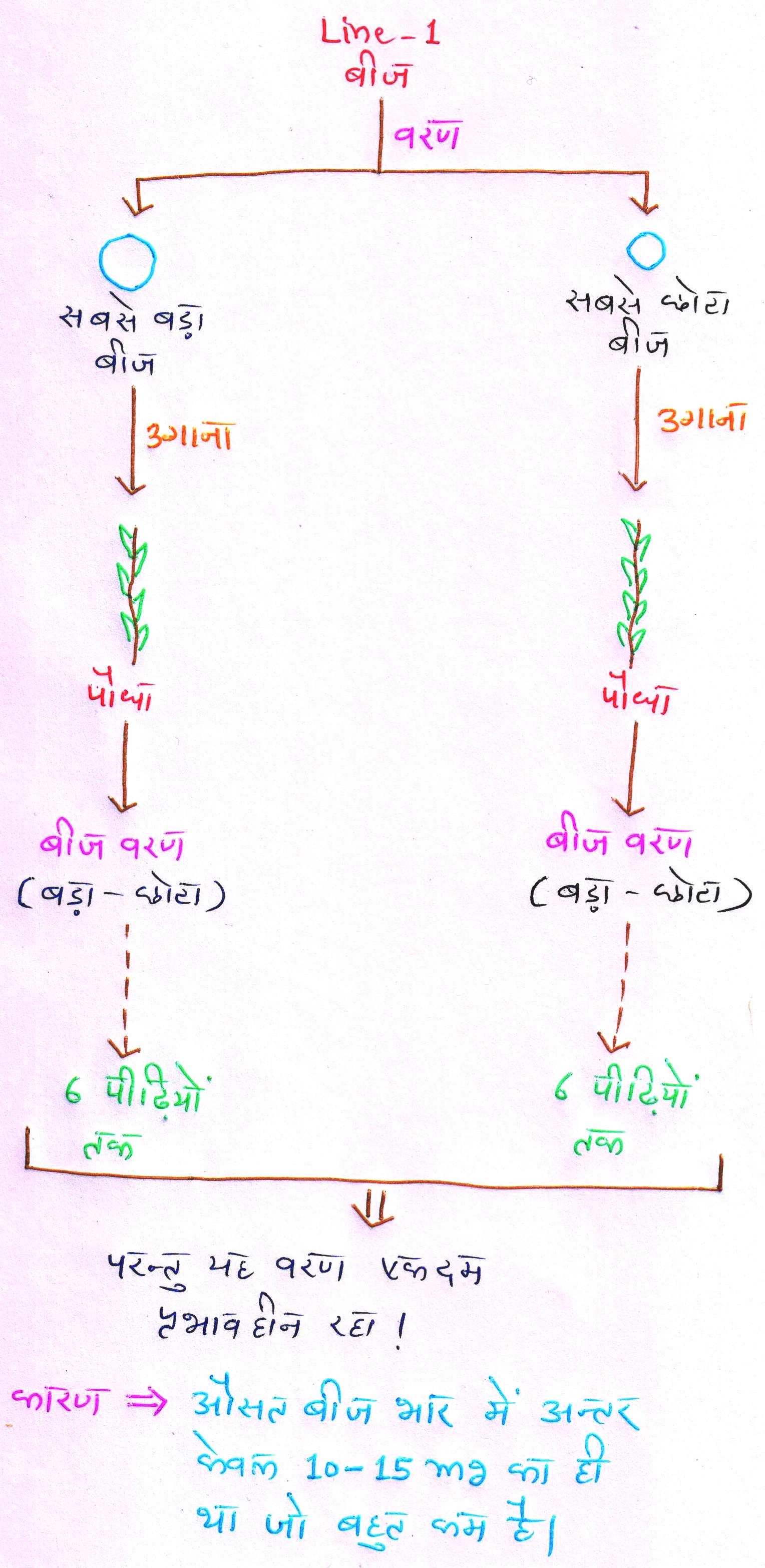
• इस सिद्धान्त का प्रतिपादन Johannsen ने 1903 में किया था। इसने राजमा (Phaseolus vulgaris) की Princess किस्म पर अध्ययन करके यह सिद्धान्त प्रस्तुत किया। जैसा कि नीचे flowchart में प्रदर्शित किया गया है।
(This theory was formulated by Johannsen in 1903. He presented this theory by studying the princess variety of beans (Phaseolus vulgaris). As demonstrated in the flowchart below.)

अब Johannsen ने एक line को लेकर प्रयोग किए:-
(Now Johannsen did experiments with a line: -)

परिणाम (Result):- एक line के बीज आमाप में विविधता केवल वातावरण के कारण थी और वह वंशागत नहीं थी।
(The variations in the seed size of a line was due only to the environment and was not hereditary.)
.png)
Intergeneric Hybrids (अंतरवंशीय संकर):- These are hybrids produced by crossing two different genera (not just different species). Because the parental genomes are quite distant, these hybrids usually show poor chromosome pairing, low fertility, or complete sterility—unless chromosome doubling is done.
[ये दो अलग-अलग वंशों (न केवल अलग-अलग प्रजातियों) के संकरण से उत्पन्न संकर होते हैं। क्योंकि जनक जीनोम काफी भिन्न होते हैं, इसलिए इन संकरों में आमतौर पर गुणसूत्र युग्मन की कमी, कम प्रजनन क्षमता या पूर्ण बांझपन देखा जाता है—जब तक कि गुणसूत्रों का द्विगुणन न किया जाए।]
Key Characteristics (मुख्य विशेषताएं):-
> Parents belong to different genera
(जनक अलग-अलग वंशों से संबंधित होते हैं)
> Low genetic homology → irregular meiosis
(कम आनुवंशिक समरूपता → अनियमित अर्धसूत्री विभाजन)
> Hybrids often weak or sterile
(संकर अक्सर कमजोर या बांझ होते हैं)
> Fertility can be restored by chromosome doubling (amphidiploidy)
[गुणसूत्रों के द्विगुणन (एम्फिडिप्लॉयडी) द्वारा प्रजनन क्षमता को बहाल किया जा सकता है]
> Important in plant breeding for trait transfer
(पादप प्रजनन में लक्षण स्थानांतरण के लिए महत्वपूर्ण)
Classic Examples (क्लासिक उदाहरण):-
i. Triticale (× Triticosecale) [ट्रिटिकेल (× ट्रिटिकोसेकेल)]:-
> Cross: Triticum (wheat) × Secale (rye)
[संकरण: ट्रिटिकम (गेहूं) × सेकेल (राई)]
> Combines wheat yield + rye hardiness
(गेहूं की उपज और राई की कठोरता का संयोजन)
ii. Raphanobrassica (रैफेनोब्रेसिका):-
> Cross: Raphanus (radish) × Brassica (cabbage)
[संकरण: रैफेनस (मूली) × ब्रासिका (पत्तागोभी)]
> Famous example of chromosome doubling restoring fertility
(गुणसूत्रों के द्विगुणन द्वारा प्रजनन क्षमता की बहाली का प्रसिद्ध उदाहरण)
.png)
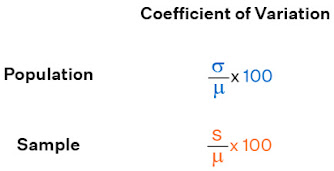
Co-efficient of variation:- In statistic, the Coefficient of variation formula (CV), also known as relative standard deviation (RSD), is a standardized measure of the dispersion of a probability distribution or frequency distribution. When the value of the coefficient of variation is lower, it means the data has less variability and high stability.
The formula for coefficient of variation is given below:
σ = Standard deviation of the population
S = Standard deviation of the sample
μ = Mean
गुणांक का परिवर्तन:- सांख्यिकी में, विचरण गुणांक (CV), जिसे सापेक्ष मानक विचलन (RSD) भी कहा जाता है, किसी प्रायिकता वितरण या आवृत्ति वितरण के फैलाव का मानकीकृत माप है। विचरण गुणांक का मान जितना कम होता है, इसका अर्थ है कि डेटा में परिवर्तनशीलता कम है और स्थिरता अधिक है।
विचरण गुणांक का सूत्र नीचे दिया गया है:
σ = जनसंख्या का मानक विचलन
S = नमूने का मानक विचलन
μ = माध्य

निराकरणीय परिकल्पना (Null Hypothesis):- काई वर्ग परीक्षण में सबसे पहले यह मान लेते हैं कि प्राप्त आंकड़े प्रत्याशित अनुपात में हैं तथा विचलन केवल संयोग मात्र है अथवा वातावरण के कारण है।
(In the chi square test, it is first assumed that the data obtained are in the expected ratio and the deviation is just coincidence or is due to the environment.)
Ø अब यदि परिकलित मान सारणी मान से कम आता है तो निराकरणीय परिकल्पना सही होती है।
(Now if the calculated value is less than the table value, then the null hypothesis is true.)
Ø और यदि परिकलित मान सारणी मान से अधिक आता है तो निराकरणीय परिकल्पना गलत होती है।
(And if the calculated value is more than the table value, then the null hypothesis is false.)

.png)
Complete Linkage (पूर्ण लिंकेज):- It is a genetic condition in which two or more genes are located so close together on the same chromosome that they are always inherited together and no crossing over occurs between them.
(यह एक आनुवंशिक स्थिति है जिसमें दो या दो से अधिक जीन एक ही गुणसूत्र पर इतने निकट स्थित होते हैं कि वे हमेशा एक साथ वंशानुगत होते हैं और उनके बीच कोई क्रॉसिंग ओवर नहीं होता है।)
Key Points (मुख्य बिंदु):-
> Genes lie very close on the same chromosome
(जीन एक ही गुणसूत्र पर बहुत निकट स्थित होते हैं)
> Crossing over is absent
(क्रॉसिंग ओवर अनुपस्थित होता है)
> Only parental (non-recombinant) combinations are produced
[केवल पैतृक (गैर-पुनर्संयोजित) संयोजन ही उत्पन्न होते हैं]
> Recombination frequency = 0%
(पुनर्संयोजन आवृत्ति = 0%)
> Rare in nature, but seen in male Drosophila (fruit fly)
[प्रकृति में दुर्लभ, लेकिन नर ड्रोसोफिला (फल मक्खी) में देखा जाता है]
Example (उदाहरण):- In male Drosophila, genes like body color and wing shape show complete linkage because crossing over does not occur in males.
(नर ड्रोसोफिला में, शरीर के रंग और पंखों के आकार जैसे जीन पूर्ण लिंकेज दर्शाते हैं क्योंकि नर में क्रॉसिंग ओवर नहीं होता है।)

Inhibitory Genes:- It is a dominant allele which has no character of its own. But inhibit the expression of the another non-allele. In this, the phenotypic ratio is changed to 13 : 3.
Example:- Color of leaves in paddy
अवरोधक जीन:- यह एक प्रभावी एलील है जिसका अपना कोई लक्षण नहीं होता, लेकिन यह दूसरे गैर-प्रभावी एलील की अभिव्यक्ति को रोकता है। इसमें, फीनोटाइपिक अनुपात 13:3 में बदल जाता है।
उदाहरण:- धान की पत्तियों का रंग
.png)
अंत:प्रजनन ह्रास (Inbreeding Depression):-
• परिभाषा (Definition):-
परपरागित फसलों में जब बार बार स्वपरागण कराया जाता है तो उनकी ओज में कमी आ जाती है। इसे ही अंत: प्रजनन ह्रास कहते हैं।
(When selfing is done repeatedly in cross-pollinated crops, their vigor get reduced. This is called inbreeding depression.)
• निकटता से संबन्धित पौधों में क्रॉस के कारण यह उत्पन्न होती है।
(It is caused by crosses in closely related plants.)
• इस प्रक्रिया में विषमयुग्मनजता में कमी आती है तथा समयुग्मनजता बढ़ती जाती है।
(In this process, heterozygosity decreases and homozygosity increases.)
• यह प्रतिकूलित अप्रभावी जीनों के स्थिरीकरण के कारण होती है।
(This is caused by fixation of unfavorable recessive genes.)
.png)
उत्परिवर्तन प्रजनन - विधियाँ व उपयोग (Mutation Breeding - Methods and Uses):-
उत्परिवर्तन (Mutation):-
• परिभाषा (Definition):- जब किसी पौधे के किसी लक्षण में आकस्मिक व वंशागत परिवर्तन होता है तो इसे उत्परिवर्तन कहते हैं।
(When there is an accidental and heritable change in a character of a plant, it is called mutation.)
• यह 2 कारणों से होती है –
(This occurs due to 2 reasons -)
i. जीन की संरचना में परिवर्तन
(Change in structure of gene)
ii. गुणसूत्रीय अनियमिततायें
(Chromosomal aberrations)
• शब्द “Mutation”:- Hugo de Vries ने 1910 में दिया।
(Word "Mutation" was given by Hugo de Vries in 1910.)
• खोज (Discovery):- उत्परिवर्तन की खोज T. H. Morgan ने 1910 में की जब उसने Drosophila का White Eye mutant देखा।
(The mutation was discovered by T. H. Morgan in 1910 when he observe the White Eye mutant of Drosophila.)
अभिलक्षण (Characteristics):-
• उत्परिवर्तित युग्मविकल्पी अप्रभावी होते हैं।
(Mutated alleles are recessive.)
• उत्परिवर्तन यादृछित घटना है।
(Mutation is a random event.)
• संयोग पर निर्भर करती है।
(It depends on coincidence.)
• अधिकांश उत्परिवर्तन हानिकारक होते हैं। परन्तु केवल 0.1% उत्परिवर्तन लाभदायक होते हैं जिनका पादप प्रजनन में उपयोग संभव है।
(Most mutations are harmful. But only 0.1% mutations are beneficial which can be used in plant breeding.)
प्रकार (Types):-
i. स्वत:उत्परिवर्तन (Spontaneous mutation):-
Ø प्रकृति में स्वत:उत्परिवर्तन अपने आप होते हैं।
(In nature, spontaneous mutations occur automatically.)
Ø विभिन्न जीन उत्परिवर्तन की भिन्न दर प्रदर्शित करते हैं।
(Different genes exhibit different rates of mutation.)
Ø कुछ जीन उच्च उत्परिवर्तन दर प्रदर्शित करते हैं जिन्हें Mutable genes कहते हैं।
(Some genes exhibit high mutation rates known as mutable genes.)
ii. प्रेरित उत्परिवर्तन (Induced mutation):-
Ø कोशिका चक्र की S – प्रावस्था के दौरान कोशिकाओं को mutagens से उपचारित करके उत्परिवर्तन को प्रेरित किया जा सकता है।
(Mutations can be induced by treating cells with mutagens during the S-phase of the cell cycle.)
Ø वातावरण भी प्रेरित उत्परिवर्तन की दर को प्रभावित करता है।
(The environment also affects the rate of induced mutation.)
उत्परिवर्तनजन (Mutagens):-
• परिभाषा (Definition):- ऐसे भौतिक या रासायनिक कारक जो उत्परिवर्तन को प्रेरित करते हैं, उत्परिवर्तनजन कहलाते हैं।
(Physical or chemical factors that induce mutation are called mutagens.)
• प्रकार (Types):- उत्परिवर्तनजन 2 प्रकार के होते हैं -
(There are 2 types of mutagens -)
a. भौतिक उत्परिवर्तनजन (Physical mutagens)
b. रासायनिक उत्परिवर्तनजन (Chemical mutagens)
a. भौतिक उत्परिवर्तनजन (Physical mutagens):- ये 2 प्रकार के होते हैं -
(These are of 2 types -)
i. आयनकारी विकिरण (Ionizing radiations):- जो परमाणुओं को धनयनों या ऋणायनों में परिवर्तित कर देते हैं।
(Which convert atoms into cations or anions.)
उदाहरण:- X – किरणें, गामा किरणें, न्यूट्रोंस, α – कण, β – किरणें।
(Examples: - X - rays, gamma rays, neutrons, α - particles, β - rays.)
ii. अनायनकारी विकिरण (Non – ionizing radiations):- जो परमाणुओं का आयनीकरण नहीं करते हैं।
(Which do not ionize atoms.)
उदाहरण:- UV किरणें
(Example: - UV rays)
b. रासायनिक उत्परिवर्तनजन (Chemical mutagens):- ये कई प्रकार के होते हैं -
(These are of many types -)
i. एल्किलीकरन कारक (Alkylating agents):- ये रसायन एल्किल समूह को DNA पर स्थानांतरित करते हैं। यह स्थानांतरण गुआनिन के N – वलय पर होता है।
(These chemicals transfer the alkyl group to DNA. This transfer occurs at the N-ring of Guanin.)
उदाहरण (Examples):-
EMS (Ethyl Methane Sulfonate),
MMS (Methyl Methane Sulfonate),
EI (Ethylene Imine)
ii. अंतरविष्टिकरन कारक (Intercalating agents):- इन रसायनों के अणु DNA के दो क्षारकों के बीच की जगह में प्रवेश कर जाते हैं। इस प्रक्रिया को अंतरविष्टिकरन कहते हैं।
(The molecules of these chemicals enter the space between the any two bases of DNA. This process is called intercalation.)
उदाहरण (Examples):-
Acriflavin, Proflavin, Acridine orange, EtBr (Ethidium Bromide)
iii. क्षार एनालॉग (Base analogues):- इन रसायनों के अणु संरचना में DNA क्षारकों से एकदम मिलते जुलते होते हैं। अत: DNA replication के दौरान ये आसानी से DNA में समावेशित हो जाते हैं।
(The molecules of these chemicals are very similar in structure to DNA bases. Thus, they are easily incorporated into DNA during DNA replication.)
उदाहरण (Examples):-
5 – BU (5 – Bromo Uracil),
5 – CU (Chloro Uracil)
iv. अन्य रसायन (Other Chemicals):- कुछ अन्य रसायन भी उत्परिवर्तनजन के रूप में उपयोग किए जाते हैं।
(Some other chemicals are also used as mutagens.)
उदाहरण (Examples):-
नाइट्रस अम्ल (Nitrous Acid) = HNO2
सोडियम एजाइड (Sodium Azide) = NaN3
हाइड्रॉक्सिल एमीन (Hydroxyl Amine) = NH2OH
इष्टतम मात्रा (Optimum Dose):- उत्परिवर्तनजन की वह मात्रा जो पौधों में न्यूनतम मृत्युदर व अधिकतम उत्परिवर्तन दर उत्पन्न करती है, इष्टतम मात्रा कहलाती है।
(The amount of mutagen that produces the lowest mortality and maximum mutation rate in plants is called the optimum dose.)
उदाहरण:-
LD50 = यह पौधों में 50% मृत्यु दर उत्पन्न करती है। (LD = Lethal Dose)
[LD50 = It produces 50% mortality in plants. (LD = Lethal Dose)]
व्यापीकृत रूपरेखा (Generalized Outline):- उत्परिवर्तन प्रजनन की विधि निम्न प्रकार से प्रदर्शित की जा सकती है –
(The method of mutation breeding can be demonstrated as follows -)
.png)
काई – वर्ग परीक्षण (Chi – square Test):-
· परीक्षणों से प्राप्त आंकड़ों के परिणाम प्रत्याशित परिणामों से थोड़ा बहुत भिन्न होते हैं।
(The results of the data obtained from the tests differ slightly from the expected results.)
· काई वर्ग परीक्षण प्राप्त तथा प्रत्याशित आंकड़ों में विसंगति के अंश को मालूम करने में सहायक होता है।
(The chi square test is helpful in finding out the degree of discrepancy between the obtained and expected data.)
· काई वर्ग परीक्षण के सांख्यिकीय विधि है जिसका प्रयोग यह निर्धारित करने के लिए किया जाता है कि किसी परीक्षण से प्राप्त आंकड़ों के विभिन्न वर्ग एक निश्चित प्रत्याशित अनुपात में हैं अथवा नहीं।
(A chi-square test is a statistical method used to determine whether different classes of data obtained from a test are in a correct expected ratio or not.)
· प्रेक्षणों की संख्या (Number of Observations):- यह 5 से 50 तक हो सकती है। प्रेक्षणों की संख्या जितनी अधिक होगी, प्राप्त निष्कर्ष उतने ही अधिक सही होंगे।
(It can range from 5 to 50. The greater the number of observations, the more correct conclusions are obtained.)
· फॉर्मूला (Formula):-
· काई वर्ग का सारणी मान (Table Value of Chi square):- परिकलित काई वर्ग मान की सारणी में काई वर्ग मान से तुलना की जाती है जिससे परिणाम प्राप्त होता है। काई वर्ग का सारणी मान 2 बातों पर निर्भर करता है –
(The calculated chi square value is compared with the chi square value in the table to get the result. The table value of a chi square depends on 2 factors –)
i. स्वतंत्रता की कोटि (Degree of freedom):-
ii. सार्थकता (Significance):- प्रायिकता स्तर 0.05 के समक्ष स्वतंत्रता कोटि के सामने काई वर्ग का मान देखते हैं।
(Find the value of the chi square in front of the degree of freedom against the probability level 0.05.)
Ø यदि परिकलित मान सारणी मान से कम आता है तो इसका अर्थ है कि विचलन सार्थक नहीं है। प्राप्त आंकड़े प्रत्याशित अनुपात में हैं। विचलन केवल संयोग मात्र है अथवा वातावरण के कारण है।
(If the calculated value is less than the table value, it means that the deviation is not significant. The data obtained are in the expected ratio. The deviation is just a coincidence or is due to the environment.)
Ø यदि परिकलित मान सारणी मान से अधिक आता है तो इसका अर्थ है कि विचलन सार्थक है। प्राप्त आंकड़े प्रत्याशित अनुपात में नहीं हैं। विचलन आनुवंशिक कारकों के कारण है।
(If the calculated value is greater than the table value, it means that the deviation is significant. The data obtained are not in the expected ratio. The deviation is due to genetic factors.)
· काई वर्ग सारणी (Chi – square table):-
· P0.05:- 5% प्रयोगों में परिकलित काई वर्ग का मान सारणी मान से अधिक संयोगवश हो सकता है। यदि 5% से अधिक प्रयोगों में ऐसा होता है तो विचलन संयोगवश न होकर किन्हीं अन्य कारणों से होता है।
(In 5% of experiments, the calculated chi square value may be more than the table value by coincidence. If this happens in more than 5% of the experiments, then the deviation is not a coincidence but due to some other reason.)

Kurtosis:- It is also a characteristic of the frequency distribution. It gives an idea about the shape of a frequency distribution. Basically, the measure of kurtosis is the extent to which a frequency distribution is peaked in comparison with a normal curve. It is the degree of peakedness of a distribution.
Types of kurtosis:-
1. Leptokurtic:- Leptokurtic is a curve having a high peak than the normal distribution. In this curve, there is too much concentration of items near the central value.
2. Mesokurtic:- Mesokurtic is a curve having a normal peak than the normal curve. In this curve, there is equal distribution of items around the central value.
3. Platykurtic:- Platykurtic is a curve having a low peak than the normal curve is called platykurtic. In this curve, there is less concentration of items around the central value.
कुर्टोसिस:- यह भी आवृत्ति वितरण की एक विशेषता है। यह आवृत्ति वितरण के आकार के बारे में जानकारी देता है। मूलतः, कुर्टोसिस का माप यह दर्शाता है कि सामान्य वक्र की तुलना में आवृत्ति वितरण कितना अधिक शिखरित है। यह वितरण के शिखरित होने की मात्रा है।
कुर्टोसिस के प्रकार:-
1. लेप्टोकुर्टिक:- लेप्टोकुर्टिक एक ऐसा वक्र है जिसका शिखर सामान्य वितरण की तुलना में अधिक ऊँचा होता है। इस वक्र में, केंद्रीय मान के निकट वस्तुओं का अत्यधिक संकेंद्रण होता है।
2. मेसोकर्टिक:- मेसोकर्टिक एक ऐसा वक्र है जिसका शिखर सामान्य वक्र की तुलना में अधिक चौड़ा होता है। इस वक्र में, केंद्रीय मान के चारों ओर वस्तुओं का समान वितरण होता है।
3. प्लैटिकर्टिक:- प्लैटिकर्टिक वक्र वह वक्र कहलाता है जिसका शिखर सामान्य वक्र की तुलना में नीचा होता है। इस वक्र में केंद्रीय मान के आसपास वस्तुओं का संकेंद्रण कम होता है।
.png)
.png)
Parallelism between Mendelism and Meiosis (मेंडलवाद और अर्धसूत्री विभाजन के बीच समानता):- Mendel’s laws are the genetic rules; meiosis is the cellular process that makes those rules happen.
(मेंडल के नियम आनुवंशिक नियम हैं; अर्धसूत्री विभाजन वह कोशिकीय प्रक्रिया है जो इन नियमों को क्रियान्वित करती है।)
Parallel Table (समानांतर सारणी):-
Mendelism (Law / Concept) - Meiosis (Cytological Basis) [मेंडलवाद (नियम/अवधारणा) - अर्धसूत्री विभाजन (कोशिकाविज्ञानीय आधार)]:-
> Genes occur in pairs - Chromosomes occur in homologous pairs.
(जीन युग्मों में पाए जाते हैं - गुणसूत्र समजात युग्मों में पाए जाते हैं।)
> Law of Dominance: One allele may mask another - Only one allele is present in each gamete after reduction division.
(प्रभाविता का नियम: एक एलील दूसरे को ढक सकता है - अपचयन विभाजन के बाद प्रत्येक युग्मक में केवल एक ही एलील मौजूद होता है।)
> Law of Segregation: Allele pairs separate during gamete formation - Homologous chromosomes separate at Anaphase-I.
[पृथक्करण का नियम: युग्मक निर्माण के दौरान एलील युग्म अलग हो जाते हैं - समजात गुणसूत्र प्रथम चरण में अलग होते हैं।]
> Gametes are pure - Meiosis produces haploid gametes.
(युग्मक शुद्ध होते हैं - अर्धसूत्री विभाजन से अगुणित युग्मक बनते हैं।)
> Law of Independent Assortment - Random orientation of bivalents at Metaphase-I.
(स्वतंत्र वर्गीकरण का नियम - प्रथम चरण में द्विसंयोजक गुणसूत्रों का यादृच्छिक अभिविन्यास।)
> Recombinant types appear - Crossing over in Prophase-I produces recombination.
(पुनर्संयोजित प्रकार प्रकट होते हैं - प्रथम चरण में पराक्रमण से पुनर्संयोजन होता है।)
> Restoration of diploid number after fertilization - Meiosis halves chromosome number, fertilization restores it.
(निषेचन के बाद द्विगुणित संख्या की बहाली - अर्धसूत्री विभाजन गुणसूत्रों की संख्या को आधा कर देता है, निषेचन इसे बहाल करता है।)
.png)
Breeding methods in self pollinated crops (स्वपरागित फसलों में प्रजनन विधियाँ):-
• आनुवांशिक आधार (Genetic Basis):-
स्वपरागण के कारण प्रत्येक पीढ़ी में विषमयुग्मनजता पिछली पीढ़ी की आधी हो जाती है और समयुग्मनजता उसी अनुपात में बढ़ती जाती है।
(Due to self-pollination, heterozygosity in each generation is reduced to half of the previous generation and homozygosity increases in the same proportion.)
• समयुग्मनजता (Homozygosity):-
किसी भी पादप समष्टि में समयुग्मनज अवस्था में उपस्थित जीनों की प्रतिशत आवृति को उस समष्टि की समयुग्मनजता कहते हैं।
(The percent frequency of genes present in the homozygous state of any plant population is called the homozygosity of that population.)
• Aa जीन प्रारूप वाले पौधों का स्वपरागण कराने पर निम्न परिणाम मिलते हैं -
(The following results are obtained by self-pollination the Aa genotype plants -)

• समयुग्मनजता जीन विनिमय के व्युत्क्रमानुपाती होती है।
(Homozygosity is inversely proportional to crossing over.)

• समयुग्मनजता सहलग्नता के समानुपाती होती है।
(Homozygosity is directly proportional to linkage.)

वरण (Selection):-
किसी पादप समष्टि में विभिन्न जीनप्रारूपों की जनन दर भिन्न भिन्न होती है, जिससे विविधतापूर्ण समष्टि का निर्माण होता है। इस विविधतापूर्ण समष्टि में से उत्कृष्ट लक्षणों वाले पौधों को छांटकर अलग करना तथा उनके बीजों से अगली पीढ़ी उगाने की प्रक्रिया को ही वरण कहते हैं।
(Different genotypes in a plant population have different reproduction rates, creating a diverse population. From this diverse plant population, the process of sorting and isolating the plants with superior characters and growing the next generation from their seeds, is called selection.)
उपरोक्त अंतरों के कारण ही दोनों प्रकार की फसलों में वरण द्वारा फसल सुधार की विधियाँ काफी भिन्न हैं।
(Due to the above differences, the methods of crop improvement by selection are quite different in both types of crops.)
प्रजनन विधियाँ (Breeding Methods):- 2 मुख्य प्रजनन विधियाँ हैं-
(2 main breeding methods are -)
1. समूह वरण (Mass Selection)
2. शुद्ध वंशक्रम वरण (Pure line Selection)
1. समूह वरण (Mass Selection):-
जब विविधतापूर्ण समष्टि में से उत्कृष्ट व एक समान पौधों का वरण करके इनके बीजों को एक साथ समूह में मिश्रित कर लेते हैं तो इस विधि को समूह वरण कहते हैं।
(When superior and uniform plants are selected from a diverse plant population, and their seeds are mixed together in a group, then it is called mass selection.)
Basic Concept:- एक समान तथा उत्कृष्ट लक्षण प्रारूप वाले अनेक पौधों का वरण करते हैं तथा इनके बीजों के मिश्रण से नई किस्म बनती है। जैसा कि नीचे diagram में प्रदर्शित किया गया है।
(Many plants with uniform and superior characteristics are selected and their seeds are mixed together to make a new variety. As shown in the diagram below.)

व्यापीकृत रूपरेखा (Generalized Outline):-

2. शुद्ध वंशक्रम वरण (Pure line Selection):-
जब विविधतापूर्ण समष्टि में से उत्कृष्ट पौधों का वरण करके इनके बीजों को अलग अलग एकत्रित कर लेते हैं व इनसे एकल पादप संततियाँ उगाते हैं तो इसे शुद्ध वंशक्रम वरण कहते हैं।
(When superior plants are selected from a diverse plant population and their seeds are collected separately to grow individual plant progenies, it is called pure line selection.)
Basic Concept:- किसी पादप समष्टि में से बहुत से उत्कृष्ट पौधों का वरण करते हैं। प्रत्येक पौधे के बीज अलग अलग एकत्रित करते हैं और इनसे एकल पादप संततियाँ उगाते हैं। इनमें से सबसे उत्तम एकल पादप संतति को नई किस्म के रूप में विमोचित करते हैं।
(Select many superior plants from a plant population. The seeds of each plant collect separately and grow individual plant progenies. The best of these individual plant progenies are released as a new variety.)

व्यापीकृत रूपरेखा (Generalized Outline):-


Correlation:-
> The term correlation is a combination of two words 'Co' (together) and the relation between two quantities. Correlation is when it is observed that a change in a unit in one variable is retaliated by an equivalent change in another variable, i.e., direct or indirect, at the time of study of two variables. Or else the variables are said to be uncorrelated when the motion in one variable does not amount to any movement in a specific direction in another variable. It is a statistical technique that represents the strength of the linkage between variable pairs.
> Correlation can be either negative or positive. If the two variables move in the same direction, i.e. an increase in one variable results in the corresponding increase in another variable, and vice versa, then the variables are considered to be positively correlated. For example, Investment and profit.
> On the contrary, if the two variables move in different directions so that an increase in one variable leads to a decline in another variable and vice versa, this situation is known as a negative correlation. For example, Product price and demand.
Correlation Analysis:-
- Correlation analysis is applied in quantifying the association between two continuous variables, for example, an dependent and independent variable or among two independent variables.
- The sample of a correlation coefficient is estimated in the correlation analysis. It ranges between -1 and +1, denoted by r and quantifies the strength and direction of the linear association among two variables. The correlation among two variables can either be positive, i.e. a higher level of one variable is related to a higher level of another or negative, i.e. a higher level of one variable is related to a lower level of the other.
- The sign of the coefficient of correlation shows the direction of the association. The magnitude of the coefficient shows the strength of the association.
- For example, a correlation of r = 0.8 indicates a positive and strong association among two variables, while a correlation of r = -0.3 shows a negative and weak association. A correlation near to zero shows the non-existence of linear association among two continuous variables.
सह - संबंध:-
सहसंबंध शब्द दो शब्दों 'सह' (एक साथ) और 'दो राशियों के बीच संबंध' का संयोजन है। सहसंबंध तब कहलाता है जब एक चर में एक इकाई परिवर्तन होने पर दूसरे चर में भी उतना ही परिवर्तन होता है, यानी प्रत्यक्ष या अप्रत्यक्ष रूप से। इसके विपरीत, जब एक चर में परिवर्तन होने पर दूसरे चर में कोई परिवर्तन नहीं होता, तो चर असंबंधित कहलाते हैं। यह एक सांख्यिकीय तकनीक है जो चर युग्मों के बीच संबंध की मजबूती को दर्शाती है।
सहसंबंध ऋणात्मक या धनात्मक हो सकता है। यदि दो चर एक ही दिशा में गति करते हैं, अर्थात् एक चर में वृद्धि होने पर दूसरे चर में भी उतनी ही वृद्धि होती है, और इसके विपरीत भी, तो इन चरों को धनात्मक रूप से सहसंबंधित माना जाता है। उदाहरण के लिए, निवेश और लाभ।
इसके विपरीत, यदि दो चर अलग-अलग दिशाओं में गति करते हैं, जिससे एक चर में वृद्धि दूसरे चर में कमी लाती है और इसके विपरीत भी, तो इस स्थिति को नकारात्मक सहसंबंध कहा जाता है। उदाहरण के लिए, उत्पाद की कीमत और मांग।
सहसंबंध विश्लेषण:-
सहसंबंध विश्लेषण का उपयोग दो सतत चरों के बीच संबंध को मापने के लिए किया जाता है, उदाहरण के लिए, एक आश्रित और एक स्वतंत्र चर या दो स्वतंत्र चरों के बीच।
सहसंबंध विश्लेषण में सहसंबंध गुणांक का नमूना अनुमानित किया जाता है। इसका मान -1 से +1 के बीच होता है, जिसे r से दर्शाया जाता है और यह दो चरों के बीच रैखिक संबंध की शक्ति और दिशा को मापता है। दो चरों के बीच सहसंबंध धनात्मक हो सकता है, अर्थात् एक चर का उच्च स्तर दूसरे चर के उच्च स्तर से संबंधित होता है, या ऋणात्मक हो सकता है, अर्थात् एक चर का उच्च स्तर दूसरे चर के निम्न स्तर से संबंधित होता है।
सहसंबंध गुणांक का चिह्न संबंध की दिशा दर्शाता है। गुणांक का परिमाण संबंध की मजबूती को दर्शाता है।
उदाहरण के लिए, r = 0.8 का सहसंबंध दो चरों के बीच एक सकारात्मक और मजबूत संबंध दर्शाता है, जबकि r = -0.3 का सहसंबंध एक नकारात्मक और कमजोर संबंध दर्शाता है। शून्य के निकट का सहसंबंध दो सतत चरों के बीच रैखिक संबंध के न होने को दर्शाता है।

.png)
.png)


.png)




.png)
.png)


.png)


.png)
.png)


.png)


.png)
.png)
.png)


Comments
Post a Comment