2018 Solved Old Paper (BOT - 303D) New OK
.png)
Plant tissue culture: A historical perspective (पादप ऊतक संवर्धन: एक ऐतिहासिक परिप्रेक्ष्य)
पादप ऊतक संवर्धन का इतिहास (History of Plant Tissue Culture):-
· Haberlandt (1902):- "कायिक कोशिकाओं से भ्रूण का विकास संभव है। ’’ यह विचार इनके द्वारा 1902 में दिया गया था। इन्होंने Lamium purpureum की परिपक्व पर्ण की कोशिकाओं और Tradescantia व Pulmonaria की रोम कोशिकाओं को 1 - 5% सुक्रोज युक्त नौप के विलयन में संवर्धित करने का प्रयास किया परन्तु सफलता नहीं मिली।
(‘’It is possible to grow embryos from somatic cells.’’ This idea was visualized by him in 1902. He tried to grow the mature leaf cells of Lamium purpureum and hair cells of Tradescantia and Pulmonaria in knop’s solution containing 1 – 5% sucrose without success.)
· Robbins and Kotte (1922):- इन्होने स्वतंत्र रूप से सीमित अवधि के लिए मक्का और मटर के मूल शिखाग्र को संवर्धित करने में सफलता प्राप्त की थी।
(They independently were able to grow the root tips of maize and pea for a limited period.)
· White (1922):- इन्होंने अकार्बनिक लवण, खमीर निष्कर्ष और सुक्रोज युक्त द्रव माध्यम में टमाटर (Lycopersicum esculentum) के मूल शिखाग्र को सतत रूप से लम्बी अवधि तक संवर्धित करने में सफलता प्राप्त की थी।
[He successfully grew the root tips of tomato (Lycopersicum esculentum) continuously for a prolonged period in liquid medium containing inorganic salts, yeast extract and sucrose.]
· Kogl (1934):- इन्होंने बताया कि Went (1926) द्वारा खोजा गया वृद्धि पदार्थ IAA (इंडोल एसिटिक एसिड) था।
[He reported that the growth substance invented by Went (1926) was IAA (Indole Acetic Acid).]
· Snow (1935):- इन्होंने एधा सक्रियता को उत्तेजित करने के लिए IAA की क्षमता का प्रदर्शन किया।
(He demonstrated the ability of IAA to stimulate cambial activity.)
· White, Nobecourt and Goutheret (1939):- इन्होंने साथ साथ और स्वतंत्र रूप से टमाटर, Salix capraea व Populus nigra के कैलस संवर्धनों को लम्बी अवधि के लिए स्थापित करने में सफलता प्राप्त की।
(They simultaneously and independently reported establishment of tomato, Salix capraea and Populus nigra callus cultures for prolonged period.)
· Nobecourt (1939):- इन्होंने गाजर के कैलस संवर्धनों में मूल विभेदन को देखा।
(He reported the differentiation of roots in callus cultures of carrot.)
· White (1939):- इन्होंने तम्बाकू के प्ररोह संवर्धनों में सफलतापूर्वक पर्णीय प्ररोह कलिकायों को प्रेरित किया।
(He successfully induced leafy shoot buds in tobacco stem cultures.)
· Since 1939 it was possible to culture:-
i. भ्रूण (Van Overbeck - 1941)
[Embryos (Van Overbeck - 1941)]
ii. एकल पृथक्कृत कोशिका (Muir - 1954)
[Single isolated cell (Muir - 1954)]
iii. निलम्बन संवर्धनों को स्थापित करना (Steward and Shantz - 1955)
[To establish suspension cultures (Steward and Shantz - 1955)]
· Dawson (1942):- इन्होंने पादप ऊत्तक संवर्धन की कृत्रिम रूप से महत्वपूर्ण मेटाबोलाइट्स के जैवसंश्लेषण करने की जन्मजात क्षमता को प्रदर्शित किया जो जैविक महत्व के अनेक द्वितीयक मेटाबोलाइट्स का उत्पादन करता है।
(He demonstrated the innate capacity of plant tissue cultures to biosynthesize important metabolites in vitro which led to the production of many secondary metabolites of vital importance.)
· Miller and Skoog (1955):-
Ø मिलर ने kinetin की खोज की।
(Miller discovered the kinetin.)
Ø Miller व Skoog ने तम्बाकू ऊतक संवर्धनों का उपयोग करके अंग निर्माण के हार्मोन द्वारा नियंत्रण की अवधारणा का प्रदर्शन किया।
(Miller and Skoog demonstrated the concept of hormonal control of organ formation using tobacco tissue cultures.)
· Steward (1958):- इन्होंने एक कायिक कोशिका की अंतर्निहित क्षमता, जो सम्पूर्ण पौधे में विकसित करती है, को प्रकट किया, जो कोशिकाओं की पूर्णशक्तता को साबित करती है।
(He revealed the inherent capacity of a somatic cell to regenerate into complete plant which proved the totipotency of cells.)
· Steward and Rienert (1958):- इन्होंने गाजर के संवर्धनों में कायिक भ्रूणजनन को देखा।
(They reported somatic embryogenesis in carrot cultures.)
· Morel (1960):- इन्होंने विभाज्योत्तक संवर्धन के द्वारा रोगजनक मुक्त ऑर्किड पौधों का उत्पादन किया और इस पद्धति का बाद में अनेक पौधों की जातियों में उपयोग किया गया।
(He produced pathogen free orchid plants through meristem culture and this method was later exploited in many plant species.)
· Guha and Maheshwari (1964):- इन्होंने Datura inoxa के परागकण या परागकोष संवर्धन से अगुणित भ्रूण और उसके बाद पौध निर्माण को प्रेरित किया।
(He induced haploid embryos and subsequently plantlets from pollen or anther cultures of Datura inoxa.)
· Cocking (1960):- इन्होंने टमाटर (Lycopersicum esculentum) के मूल शिखाग्रों से प्रोटोप्लास्ट के एंजाइमेटिक पृथक्करण को प्रदर्शित किया।
[He reported enzymatic isolation of protoplasts from root tips of tomato (Lycopersicum esculentum).]
· Power (1970):- इन्होंने प्रोटोप्लास्ट संलयन का विचार दिया।
(He gave the idea of protoplast fusion.)
· Takebe (1971):- इन्होंने तम्बाकू की पर्णमध्योत्तक कोशिकाओं से पृथक किए गए प्रोटोप्लास्ट से पौधों के निर्माण में सफलता प्राप्त की।
(He reported successful regeneration of plantlets from protoplasts isolated from tobacco mesophyll cells.)
· 1971 के बाद से अंतराजातीय व अंतरावंशीय संकरों के उत्पादन ली अनेक रिपोर्ट उपलब्ध हैं। (Bhojwani and Rajdan - 1983)
[Since 1971 many reports are available on the production of interspecific and intergeneric hyrids.(Bhojwani and Rajdan - 1983)]
· Heinz and Mee (1969, 1971):- कायिकक्लोनीय विविधों के उनके अवलोकन ने कई शोधकर्ताओं को इस दिशा में काम करने के लिए प्रोत्साहित किया और उन्हें वांछित लक्षणों युक्त किस्में जारी करने की अनुमति दी।
(Their observation of somaclonal variants encouraged many researchers to work in this direction and allowed them to release many varieties with desired characters.)
· Redenbaugh (1984):- उन्होंने कृत्रिम बीजों के उत्पादन की दृष्टि से कायिक भ्रूणों का कैप्सूलीकरण किया।
(He reported the encapsulation of somatic embryos with a view to produce artificial seeds.)
· Kitto and Janick (1985) and Ow (1986):- इन्होंने सफलतापूर्वक आनुवंशिक रूपान्तरण का प्रदर्शन किया और fire fly luciferas जीन के द्वारा रूपान्तरण से पराजैनिक तंबाकू के पौधे प्राप्त किए।
(They successfully demonstrated the genetic transformation and obtained transgenic tobacco plants by transformation of fire fly luciferase gene.)
History of Micropropagation (सूक्ष्म प्रवर्धन का इतिहास):-
· Lewis Knudson (1922):-
Ø आर्किड में प्रथम कृत्रिम भ्रूण अंकुरण। अर्थात कृत्रिम भ्रूण संवर्धन का आविष्कार।
(1st in vitro embryo germination in orchid. It means the invention of in vitro embryo culture.)
Ø आर्किड बीजों का गैर-सहजीवी अंकुरण।
(Non-symbiotic germination of orchid seeds.)
· Gavino Rotor (1949):-
Ø प्रथम कृत्रिम कायिक प्रवर्धन।
(1st in vitro vegetative propagation.)
Ø Phalaenopsis जातियों और संकरों के कायिक प्रवर्धन की एक विधि।
(A method of vegetative propagation of Phalaenopsis species and hybrids.)
· F.C. Steward (1959):- गाजर में प्रथम कायिक भ्रूणजनन।
(1st somatic embryogenesis in carrot.)
· F.C. Steward, MO Mapes and K Mears (1959):- संवर्धित कोशिकाओं की वृद्धि और संगठित विकास।
यह आदर्श रूप से 7 चरणों में किया जाता है:-
(It is ideally done in 7 stages: -)
1. कर्तोतक का चयन (Selection of Explant):-
• Explant (कर्तोतक):-
पौधे का वह भाग जिसे माध्यम पर संवर्धित करने के लिए चुना जाता है, कर्तोतक कहलाता है।
(The part of the plant which is selected for culturing on the medium is called explant.)

2. कर्तोतक का निर्जमीकरण (Sterilization of Explant):-
• कर्तोतक की सतह पर उपस्थित जीवाणुओं या कवकों के बीजाणुओं को नष्ट करने के लिए निम्न निर्जमीकारकों का उपयोग कर सकते हैं:-
(To destroy the spores of bacteria or fungi present on the surface of explant, the following sterilizing agents can be used:)
i. NaOCl = 1-1.4%
ii. Ca (OCl)2 = 9-10%
iii. H2O2 = 10-12%
iv. AgNO3 = 1%
v. Hg2Cl2 = 0.01 - 1%
3. काँच के बर्तनों का निर्जमीकरण (Sterilization of Glasswares):-
• काँच के बर्तनों का ओवन में शुष्क गर्म हवा के द्वारा निर्जमीकरण किया जाता है।
(Glass wares are sterilised by dry hot air in the oven.)

4. संवर्धन माध्यम का निर्जमीकरण (Sterilization of Culture medium):-
• संवर्धन माध्यम को ऑटोक्लेव में 121°C ताप व 15 p.s.i. दाब पर 30 मिनट के लिए निर्जमीकृत किया जाता है। ऑटोक्लेव में गर्म भाप के द्वारा निर्जमीकरण होता है।
(The culture medium is sterilised at 121 ° C temperature and 15 p.s.i. pressure in autoclave for 30 minutes. Sterilization occurs by hot steam in the autoclave.)

5. माध्यम व कर्तोतक का स्थानांतरण (Pouring and Inoculation):-
• इनके लिए LAF केबिनेट का उपयोग किया जाता है। [LAF = Laminar Air Flow]
(The LAF cabinet is used for this step.)
• LAF में पहले 15 मिनट तक UV प्रकाश द्वारा आंतरिक वातावरण को निर्जमित किया जाता है।
(In LAF first of all the internal environment is sterilised by UV light for 15 minutes.)
• LAF में हवा HEPA फिल्टर से होकर उपयोगकर्ता की ओर बहती है।
(The air in the LAF flows through the HEPA filter to the user.)
[HEPA = High Efficiency Particulate Air]
• HEPA फिल्टर का छिद्र आकार 0.3µm होता है जिसमें से 99.97% वायुजनित कण नहीं गुजर सकते।
(The pore size of HEPA filter is 0.3µm through which 99.97% of airborne particles cannot pass out.)
• Pouring:- माध्यम को ऑटोक्लेव से निकालकर LAF केबिनेट में लाते हैं। अब माध्यम को संवर्धन पात्र में डालते हैं जिनमें कर्तोतक का संवर्धन करना होता है। इसे Pouring कहते हैं।
(The medium is removed from the autoclave and brought to the LAF cabinet. Now, we pour the medium in the culture vessel, in which the explant is to be cultured. This is called Pouring.)
• Inoculation:- जब माध्यम ठंडा होकर जम जाता है तो LAF केबिनेट में कर्तोतक को संवर्धन पात्र में माध्यम पर स्थानांतरित करते हैं। इसे Inoculation कहते हैं।
(When the medium cools and freezes, the explants are transfered on to the medium in the culture vessel. This is called Inoculation.)

6. ऊष्मायन (Incubation):-
• संवर्धन पात्रों को कॉटन प्लग से बंद करके इन्हें Incubator में रखा जाता है।
(Culture vessels are sealed with cotton plugs and placed in the Incubator.)
• Incubator में ताप, प्रकाश व आर्द्रता की अनुकूलित मात्रा कर्तोतक को दी जाती है।
(A suitable amount of temperature, light and humidity is provided to the explant in the incubator.)
• कुछ सप्ताहों में कर्तोतक से पौध तैयार हो जाती है।
(In a few weeks, the seedlings are developed from explants.)


7. दृढ़ीकरण व अनुकूलन (Hardening and Acclimatization):-
• पौधे को Incubator के अनुकूलित वातावरण से निकालकर green house में स्थानांतरित किया जाता है। जहां पौधे को कुछ प्रतिकूल परिस्थितियों का सामना करना पड़ता है।
(The plant is removed from the adapted environment of the incubator and transferred to the green house. Where the plant has to face some adverse conditions.)

• 15 – 20 दिनों में पौधे green house के वातावरण में अनुकूलित हो जाते है।
(Plants adapt to the green house environment in 15 - 20 days.)
• अब इन्हें खेत की मृदा में स्थानांतरित करते हैं। यहाँ कुछ दिनों में पौधे अनुकूलित हो जाते है।
(Now they are transferred to the soil of the field. Here the plants get adapted in a few days.)

.png)
1. सामान्य परिचय (General Introduction):-
· परिभाषा (Definition):- ऊतक संवर्धन में कर्तोतक की कोशिकाओं से अपस्थानिक मूल, तने, पर्ण, पुष्प कलिका आदि के निर्माण की प्रक्रिया को अंगजनन कहते हैं।
(In tissue culture, the process of the formation of the adventitious root, stem, leaf, flower bud etc. from the cells of explant is called organogenesis.)
· अपस्थानिक (Adventitious):- जब पादप अंग का निर्माण कर्तोतक के ऐसे असामान्य उत्पत्ति बिन्दु से होता है जहाँ पहले से बना हुआ विभज्योतक अनुपस्थित होता है तो इसे अपस्थानिक अंग निर्माण कहते हैं।
(When the plant organ is produced from such an unusual point of origin in the explant where the pre-existing meristem is absent, it is called adventitious organ formation.)


2. महत्वपूर्ण शब्द (Important Terms):-
· निर्विभेदन (Dedifferentiation):- जब कर्तोतक को माध्यम पर स्थापित किया जाता है तो उसमें कोशिका विभाजन शुरू हो जाता है जिससे अविभेदित कोशिकाओं का एक समूह बनता है जिसे कैलस कहते हैं। कर्तोतक की कोशिकाएं विभेदित होती हैं जबकि कैलस की कोशिकाएं अविभेदित होती हैं। इस प्रकार विभेदित कोशिकाओं से अविभेदित कोशिकाओं का निर्माण होता है। यह प्रक्रिया निर्विभेदन कहलाती है।
(When the explant is placed on the medium, cell division begins in it, forming a group of undifferentiated cells called callus. The cells of the explant are differentiated while the cells of the callus are undifferentiated. Thus undifferentiated cells are formed from differentiated cells. This process is called dedifferentiation.)


· पुनर्विभेदन (Redifferentiation):- कैलस की कुछ कोशिकाएं अंग आध्यकों में विभेदित हो जाती हैं जो विभज्योतक कोशिकाओं को उत्पन्न करते हैं जिनसे पादप के अंगों का निर्माण होता है। इस प्रकार कैलस की अविभेदित कोशिकाओं के विभेदन से पादप अंगों का निर्माण होता है। इसे पुनर्विभेदन कहते हैं।
(Some cells of the callus differentiate into organ primordia that produce meristematic cells from which plant organs are formed. Thus differentiation of the undifferentiated cells of the callus creates plant organs. This is called redifferentiation.)


· Caulogenesis:- जब कैलस ऊतक से केवल अपस्थानिक प्ररोह कलिका का निर्माण होता है तो इसे Caulogenesis कहते हैं।
(When only the adventitious shoot is formed from the callus tissue, it is called Caulogenesis.)


· Rhizogenesis:- जब कैलस ऊतक में केवल अपस्थानिक मूल का निर्माण होता है तो इसे Rhizogenesis कहते हैं।
(When only the adventitious root is formed from the callus tissue, it is called Rhizogenesis.)


· Organoids:- कभी – कभी अंगजनन के दौरान त्रुटि आ जाने के कारण अनियमित संरचना का निर्माण होता है जो अंग समान दिखाई देती है। इसे organoid कहते हैं। इसमें अधिचर्मी, संवहनी व भरण ऊतक उपस्थित होता है। इसका निर्माण कैलस की परिधीय कोशिकाओं से होता है।
(Sometimes an error occurs during organogenesis leading to the formation of irregular structure that looks similar to the organ. This is called organoid. It contains epidermal, vascular and ground tissue. It is formed from peripheral cells of the callus.)
· Meristemoids:- यह विभज्योतक कोशिकाओं का एक स्थानीय समूह है जो कैलस ऊतक में बनता है तथा जिससे आगे चलकर पादप अंग बनते हैं।
(It is a local group of meristematic cells that are formed in the callus tissue and subsequently form plant organs.)
3. इतिहास (History):-
· F. Skoog (1944):- इसने बताया कि कृत्रिम अंगजनन रसायनों के द्वारा नियमित होता है। इसने देखा कि संवर्धन माध्यम में Auxin डालने पर मूल निर्माण प्रेरित होता है तथा प्ररोह निर्माण रुक जाता है।
(He reported that artificial organogenesis is regulated by chemicals. He observed that the addition of Auxin in the culture medium induced the root formation and inhibit shoot formation.)
· F. Skoog and C. Tsui (1948):-
इन्होने देखा कि संवर्धन माध्यम में Adenine Sulphate डालने पर प्ररोह निर्माण प्रेरित होता है। अर्थात यह Auxin के विपरीत प्रभाव डालता है।
(They observed that addition of Adenine Sulphate into the culture medium induced shoot formation. That is, it has the opposite effect of Auxin.)
· F. Skoog and C. O. Miller (1957):-
इन्होने एक अवधारणा दी कि अंगजनन Cytokinin व Auxin के मध्य संतुलन से नियंत्रित होता है। Cytokinin की उच्च मात्रा प्ररोह निर्माण को प्रेरित करती है जबकि Auxin की उच्च मात्रा मूल निर्माण को प्रेरित करती है।
(He gave a concept that organogenesis is controlled by the balance between Cytokinin and Auxin. High amounts of cytokinin induce shoot formation whereas high amounts of auxin induce root formation.)
· J. G. Torrey (1966):-
इसने अवधारणा दी कि कैलस ऊतक से अंगजनन की प्रक्रिया विभज्योतक कोशिकाओं के समूह के निर्माण के साथ शुरू होती है। इस समूह को Meristemoid कहते हैं।
(He gave hypothesis that the process of organogenesis from callus tissue begins with the formation of a group of meristematic cells. This group is called Meristemoid.)
· T. A. Thorpe (1980):- इसने अवधारणा दी कि अन्तर्जात Auxin – Cytokinin संतुलन अंगजनन के प्रारम्भ में मुख्य कारक है।
(He hypothesized that endogenous Auxin - Cytokinin balance is the main factor in the initiation of organogenesis.)
· N. Everett (1982):-
इसने तंबाकू बीजपत्र संवर्धन से प्ररोह कलिका निर्माण को प्रेरित करने के लिए अन्तर्जात Ethylene की एक कारक के रूप में पहचान की थी।
(He identified endogenous ethylene as a factor to induce shoot bud formation from tobacco cotyledon culture.)
4. अंगजनन के प्रकार (Types of Organogenesis):-
संवर्धन माध्यम में हार्मोन्स के संयोजन के आधार पर अंगजनन 2 प्रकार का होता है। इनके लिए Rule of Thumb का उपयोग किया जाता है।
(Organogenesis is of 2 types depending on the combination of hormones in the culture medium. Rule of Thumb is used for this purpose.)
a. प्रत्यक्ष अंगजनन (Direct Organogenesis)
b. अप्रत्यक्ष अगजनन (Indirect Organogenesis)
a. प्रत्यक्ष अंगजनन (Direct Organogenesis):-
जब Auxin व Cytokinin की मात्रा में बहुत अधिक अन्तर रखा जाता है तो कर्तोतक से सीधे प्ररोह या मूल का निर्माण होता है। इसे प्रत्यक्ष अंगजनन कहते हैं।
(When there is a huge difference in the amount of Auxin and Cytokinin, the shoot or root is directly formed from the explant. This is called direct organogenesis.)


अनेक पौधों में कैलस के उप संवर्धन से अवांछित कायिक क्लोनीय विविधताएँ विकसित हो जाती हैं। इससे बचने के लिए प्रत्यक्ष अंगजनन किया जाता है।
(In many plants, undesirable soma-clonal variations develop by sub-culturing the callus. To avoid this, direct organogenesis is done.)
b. अप्रत्यक्ष अगजनन (Indirect Organogenesis):-
जब Auxin व Cytokinin की मात्रा को लगभग समान रखा जाता है तो कर्तोतक से कैलस का निर्माण होता है। कैलस से फिर अंग निर्माण को प्रेरित किया जाता है। इसे अप्रत्यक्ष अंगजनन कहते हैं।
(When the amount of Auxin and Cytokinin is kept almost the same, callus is formed from the explant. Callus is then induced for organ formation. This is called indirect organogenesis.)


5. अंगजनन को प्रभावित करने वाले कारक (Factors Affecting Organogenesis):-
a. भौतिक कारक (Physical Factors)
b. रासायनिक कारक (Chemical Factors)
a. भौतिक कारक (Physical Factors):-
i. प्रकाश की गुणवत्ता (Quality of Light):-
नीला प्रकाश प्ररोह निर्माण को प्रेरित करता है जबकि लाल प्रकाश मूल निर्माण को प्रेरित करता है।
(Blue light induces shoot formation while red light induces root construction.)
ii. तापमान (Temperature):- 33°C तक तापमान में वृद्धि करने पर तंबाकू में कैलस की वृद्धि बढ़ जाती है। परन्तु प्ररोह कलिका विभेदन के लिए कम तापमान 18°C उपयुक्त होता है।
(Increasing the temperature up to 33 °C increases the callus growth in tobacco. But low temperature 18 ° C is suitable for shoot bud differentiation.)
b. रासायनिक कारक (Chemical Factors):-
i. पादप हार्मोन्स (Plant Hormones):- Cytokinin प्ररोह कलिका निर्माण को प्रेरित करता है। Auxin मूल निर्माण को प्रेरित करता है। Cytokinin में Adenine की तुलना में Kinetin 30,000 गुना अधिक प्रभावी होता है।
(Cytokinin induces shoot bud formation. Auxin induces the root formation. Kinetin is 30,000 times more effective than adenine in cytokinins.)
ii. औक्सिन अवरोधक (Auxin Inhibitors):-
माध्यम में उपस्थित होने पर ये Auxin के प्रभाव को रोक देते हैं अर्थात प्ररोह निर्माण को प्रेरित करता है।
(When present in the medium, they inhibit the effect of Auxin, it means induces shoot formation.)
उदाहरण (Examples):-
Ø फॉस्फेट (Phosphate)
Ø कैसीन हाइड्रोलाइसेट (Casein Hydrolysate)
Ø टायरोसिन (Tyrosine)
Ø ऐडेनिन (Adenine)
Ø फिनोलिक यौगिक (Phenolic Compounds)
Ø कीलेटिंग कारक (Chelating agents)
Ø ऐब्सिसिक अम्ल (Abscisic Acid)
6. लाभ (Advantages):-
· सस्ता (Cheap)
· तीव्र प्रक्रिया (Fast Process)
· विभिन्नता रहित (No variables)
· कम स्थान (Less Space)
· आसानी विधि (Easily Scale)
7. अनुप्रयोग (Applications):-
· एक Bioreactor की तरह उपयोग करते हैं।
(It is used as a bioreactor.)
· प्रोटोप्लास्ट संवर्धन (Protoplast Culture)
· जीन स्थानांतरण (Gene Transfer)
.png)
LAF (Laminar Air Flow):-
• इनके लिए LAF केबिनेट का उपयोग किया जाता है। [LAF = Laminar Air Flow]
(The LAF cabinet is used for this step.)
• LAF में पहले 15 मिनट तक UV प्रकाश द्वारा आंतरिक वातावरण को निर्जमित किया जाता है।
(In LAF first of all the internal environment is sterilised by UV light for 15 minutes.)
• LAF में हवा HEPA फिल्टर से होकर उपयोगकर्ता की ओर बहती है।
(The air in the LAF flows through the HEPA filter to the user.)
[HEPA = High Efficiency Particulate Air]
• HEPA फिल्टर का छिद्र आकार 0.3µm होता है जिसमें से 99.97% वायुजनित कण नहीं गुजर सकते।
(The pore size of HEPA filter is 0.3µm through which 99.97% of airborne particles cannot pass out.)
• Pouring:- माध्यम को ऑटोक्लेव से निकालकर LAF केबिनेट में लाते हैं। अब माध्यम को संवर्धन पात्र में डालते हैं जिनमें कर्तोतक का संवर्धन करना होता है। इसे Pouring कहते हैं।
(The medium is removed from the autoclave and brought to the LAF cabinet. Now, we pour the medium in the culture vessel, in which the explant is to be cultured. This is called Pouring.)
• Inoculation:- जब माध्यम ठंडा होकर जम जाता है तो LAF केबिनेट में कर्तोतक को संवर्धन पात्र में माध्यम पर स्थानांतरित करते हैं। इसे Inoculation कहते हैं।
(When the medium cools and freezes, the explants are transfered on to the medium in the culture vessel. This is called Inoculation.)
.png)


.png)
Biotechnology Concepts:-
• The term biotechnology was coined by Hungarian engineer Karl Ereky in 1919.
• Biotechnology is a new term but this process has been used since ancient times. For example, wine, curd, vinegar, etc. have been produced by fermentation with the help of microorganisms.
• After the discovery of RE (Restriction Endonuclease) in 1970, new methods of gene technology developed which were extremely beneficial for humans. This brought revolutionary changes in the field of Biotechnology.
• Definition:- The branch of biology in which beneficial products are made for human beings by the controlled use of biological factors such as microorganisms or the components of cells is called biotechnology.
• Old Biotechnology:- This type of biotechnology is based on the natural abilities of microbes. It has 2 main objectives -
i. Seeking new microbes with greater capabilities
ii. Improve the ability of micro organisms by selection, mutation etc.
• New Biotechnology:- In this type of biotechnology, useful potential is developed artificially. like -
i. Recombinant DNA Technology
ii. Plant Tissue Culture
iii. Monoclonal Antibody Production
iv. Embryo Transfer in Animals
• Historical Biotechnological Events:-
i. The use of yeast to make wine began around 6000 BC.
ii. The use of yeast to make bread began around 4000 BC.
iii. Sewage treatment started in 1910 with the use of microbes.
iv. Large scale production of acetone, glycerol and butanol began in 1912 with the use of bacteria.
v. Large scale production of penicillin began in 1944.
vi. Successful experiments in genetic engineering were carried out in 1973.
vii. In 1980, human foods obtained from fungi started trading in England.
viii. In 1983, the use of synthetic insulin in humans was permitted in the USA and England. This insulin was produced by bacteria which are obtained by genetic engineering.
Applications:-
1. Bio-control:- Weeds, diseases and pests are biologically controlled by the use of viruses, bacteria, fungi, etc. It does not cause any pollution in the environment.
2. Bio-fertilizers:- Rhizobium, BGA, Azolla etc. perform nitrogen fixation. They are being used in limited quantities. Azolla is widely used in paddy cultivation in Vietnam.
3. Embryo Culture:-
Ø Inter specific which are difficult to survive, can be rescued by embryo culture.
Ø Haploid plants are obtained from inter specific hybrids.
Ø Micro-propagation of orchids is done.
4. Rapid clonal multiplication:- Fruits and flowers producing plants or wild plants are multiplied by meristem culture.
5. Disease free plants:-
Ø Primarily useful for virus protection.
Ø These are achieved through meristem culture and thermotherapy (incubation).
Ø It is mainly useful in clonal crops.
6. Germplasm Conservation:-
Ø The meristem, embryo and cells are stored in liquefied nitrogen at -196 ° C.
Ø The meristem culture is kept in a slow growth state.
Ø It is particularly useful in clonal crops.
7. Isolation of homozygous lines:-
Ø Homozygous lines can be obtained by chromosomal duplication of haploid plants derived from pollen culture.
Ø In only two generations the homozygous lines are obtained.
Ø In China, more than 24 improved varieties have been developed in paddy, wheat, barley, mustard etc.
8. Genetic Engineering:-
Ø Remove the desired genes from other organisms and transfer them to plants.
Ø We do this for the following features: -
i. Insect Resistance
ii. Virus Resistance
iii. Weedicide Resistance
Ø This is a revolutionary change in crop improvement.
जैव प्रौद्योगिकी अवधारणाएँ:-
• जैव प्रौद्योगिकी शब्द का प्रयोग 1919 में हंगेरियन इंजीनियर कार्ल एरेकी ने किया था।
• जैव प्रौद्योगिकी एक नया शब्द है, लेकिन इस प्रक्रिया का उपयोग प्राचीन काल से होता आ रहा है। उदाहरण के लिए, शराब, दही, सिरका आदि का उत्पादन सूक्ष्मजीवों की सहायता से किण्वन द्वारा किया जाता रहा है।
• 1970 में RE (प्रतिबंध एंडोन्यूक्लीज) की खोज के बाद , जीन प्रौद्योगिकी की नई विधियाँ विकसित हुईं जो मनुष्यों के लिए अत्यंत लाभकारी थीं। इससे जैव प्रौद्योगिकी के क्षेत्र में क्रांतिकारी परिवर्तन आए।
• परिभाषा :- जीव विज्ञान की वह शाखा जिसमें सूक्ष्मजीवों या कोशिकाओं के घटकों जैसे जैविक कारकों के नियंत्रित उपयोग द्वारा मनुष्यों के लिए लाभकारी उत्पाद बनाए जाते हैं, जैव प्रौद्योगिकी कहलाती है।
• पुरानी जैव प्रौद्योगिकी:- इस प्रकार की जैव प्रौद्योगिकी सूक्ष्मजीवों की प्राकृतिक क्षमताओं पर आधारित है। इसके दो मुख्य उद्देश्य हैं -
i. अधिक क्षमताओं वाले नए सूक्ष्मजीवों की खोज करना
ii. चयन, उत्परिवर्तन आदि द्वारा सूक्ष्मजीवों की क्षमता में सुधार करना।
• नई जैव प्रौद्योगिकी:- इस प्रकार की जैव प्रौद्योगिकी में, उपयोगी क्षमता को कृत्रिम रूप से विकसित किया जाता है। जैसे -
i. पुनर्संयोजित डीएनए प्रौद्योगिकी
ii. पादप ऊतक संवर्धन
iii. मोनोक्लोनल एंटीबॉडी उत्पादन
iv. पशुओं में भ्रूण स्थानांतरण
• ऐतिहासिक जैव प्रौद्योगिकी संबंधी घटनाएँ:-
i. शराब बनाने के लिए खमीर का उपयोग लगभग 6000 ईसा पूर्व शुरू हुआ।
ii. रोटी बनाने में खमीर का उपयोग लगभग 4000 ईसा पूर्व शुरू हुआ।
iii. सूक्ष्मजीवों के उपयोग से 1910 में सीवेज उपचार शुरू हुआ।
iv. एसीटोन, ग्लिसरॉल और ब्यूटेनॉल का बड़े पैमाने पर उत्पादन 1912 में बैक्टीरिया के उपयोग से शुरू हुआ।
v. पेनिसिलिन का बड़े पैमाने पर उत्पादन 1944 में शुरू हुआ।
vi. आनुवंशिक अभियांत्रिकी के क्षेत्र में सफल प्रयोग 1973 में किए गए।
vii. 1980 में, कवक से प्राप्त मानव खाद्य पदार्थों का इंग्लैंड में व्यापार शुरू हुआ।
viii. 1983 में, अमेरिका और इंग्लैंड में मनुष्यों में कृत्रिम इंसुलिन के उपयोग की अनुमति दी गई थी। यह इंसुलिन बैक्टीरिया द्वारा उत्पादित किया गया था, जिसे आनुवंशिक इंजीनियरिंग द्वारा प्राप्त किया गया था।
आवेदन:-
1. जैविक नियंत्रण :- खरपतवार, रोग और कीटों को विषाणुओं, जीवाणुओं, कवक आदि के उपयोग से जैविक रूप से नियंत्रित किया जाता है। इससे पर्यावरण में कोई प्रदूषण नहीं होता है।
2. जैविक उर्वरक :- राइजोबियम, बीजानोलोजी, अजोला आदि नाइट्रोजन स्थिरीकरण करते हैं। इनका उपयोग सीमित मात्रा में किया जा रहा है। वियतनाम में धान की खेती में अजोला का व्यापक रूप से उपयोग किया जाता है।
3. भ्रूण संवर्धन :-
Ø अंतर-प्रजातिगत जीव जो जीवित रहने में मुश्किल होते हैं, उन्हें भ्रूण संवर्धन द्वारा बचाया जा सकता है।
Ø अगुणित पौधे अंतर-प्रजाति संकरों से प्राप्त किए जाते हैं।
Ø ऑर्किड का सूक्ष्म प्रसार किया जाता है।
4. तीव्र क्लोनल गुणन :- फल और फूल उत्पन्न करने वाले पौधों या जंगली पौधों कोमेरिस्टेम संवर्धन द्वारा गुणा किया जाता है।
5. रोगमुक्त पौधे :-
Ø मुख्य रूप से वायरस से सुरक्षा के लिए उपयोगी।
ये प्रक्रिया मेरिस्टेम संवर्धन और थर्मोथेरेपी (ऊष्मायन) के माध्यम से प्राप्त की जाती है।
Ø यह मुख्य रूप से क्लोनल फसलों में उपयोगी है।
6. जर्मप्लाज्म संरक्षण :-
मेरिस्टेम, भ्रूण और कोशिकाओं को -196 डिग्री सेल्सियस पर द्रवीकृत नाइट्रोजन में संग्रहित किया जाता है ।
मेरिस्टेम कल्चर को धीमी वृद्धि की अवस्था में रखा जाता है ।
Ø यह क्लोनल फसलों में विशेष रूप से उपयोगी है।
7. समरूप वंशानुक्रमों का पृथक्करण :-
पराग संवर्धन से प्राप्त अगुणित पौधों के गुणसूत्रों के दोहराव द्वारा समयुग्मजी वंश प्राप्त किए जा सकते हैं ।
Ø केवल दो पीढ़ियों में ही समयुग्मजी वंश प्राप्त हो जाते हैं।
चीन में धान, गेहूं, जौ, सरसों आदि की 24 से अधिक उन्नत किस्में विकसित की गई हैं।
8. आनुवंशिक अभियांत्रिकी :-
Ø अन्य जीवों से वांछित जीन निकालकर उन्हें पौधों में स्थानांतरित करें।
हम निम्नलिखित विशेषताओं के लिए ऐसा करते हैं:
i. कीट प्रतिरोधक क्षमता
ii. वायरस प्रतिरोध
iii. खरपतवारनाशक प्रतिरोध
Ø फसल सुधार के क्षेत्र में यह एक क्रांतिकारी बदलाव है।
.png)
Micro propagation technology (सूक्ष्म प्रवर्धन प्रौधौगिकी):-
1. सामान्य परिचय (General Introduction):-
· क्लोनीय प्रवर्धन (Clonal Propagation):- अलैंगिक जनन द्वारा एक पौधे की आनुवांशिक रूप से एक समान संततियाँ उत्पन्न करके गुणन करने की प्रक्रिया को क्लोनीय प्रवर्धन कहते हैं।
(The process of multiplication by producing genetically identical offspring of a plant by asexual reproduction is called clonal propagation.)
· प्राकृतिक क्लोनीय प्रवर्धन अधिक कठिन, खर्चीला व असफल होता है।
(Natural clonal propagation is more difficult, expensive, and unsuccessful.)
· परिभाषा (Definition):- पादप के कायिक भाग को कर्तोतक के समान उपयोग करके निर्जमित परिस्थितियों में कृत्रिम माध्यम पर संवर्धन करने की प्रक्रिया को सूक्ष्म प्रवर्धन कहते हैं। अर्थात क्लोनीय प्रवर्धन की कृत्रिम विधि को सूक्ष्म प्रवर्धन कहते हैं।
(The process of culturing the vegetative part of the plant as explant on culture medium under sterilized conditions is called micro propagation. That is, the artificial method of clonal propagation is called micro propagation.)
· क्लोन शब्द का प्रयोग सबसे पहले Weber ने किया था।
(The term clone was first used by Weber.)
· सूक्ष्म प्रवर्धन में बहुत कम जगह और बहुत कम समय में एक पौधे से बहुत अधिक संख्या में सूक्ष्म कायिक प्ररोह बना लिए जाते हैं।
(Very large number of minute vegetative shoots are produced from a plant in very little space and in a very short time in micro propagation.)
· सूक्ष्म प्रवर्धन के लिए ऊतक संवर्धन का उपयोग G. Morel ने 1960 में शुरू किया था। उसने ओर्किड प्रवर्धन के लिए इसका उपयोग किया था।
(The use of tissue culture for micro-propagation started in 1960 by G. Morel. He used it for orchid propagation.)
2. सूक्ष्म प्रवर्धन विधियाँ (Micro propagation Methods):-
i. प्ररोह शीर्षस्थ विभाज्योतक द्वारा गुणन (Multiplication by Shoot Apical Meristem)
ii. अपस्थानिक प्ररोह द्वारा गुणन (Multiplication by Adventitious Shoot)
iii. अपस्थानिक भ्रूण निर्माण द्वारा गुणन (Multiplication by Adventitious Embryo Formation)
iv. कैलस संवर्धन द्वारा गुणन (Multiplication by Callus Culture)
3. सूक्ष्म प्रवर्धन की अवस्थाएँ (Stages of Micro propagation):-
सूक्ष्म प्रवर्धन को 5 अवस्थाओं में विभाजित किया गया है –
(Micro propagation is divided into 5 stages -)
a. अवस्था – 0 (Stage - 0)
b. अवस्था – I (Stage - I)
c. अवस्था – II (Stage - II)
d. अवस्था – III (Stage - III)
e. अवस्था – IV (Stage - IV)
a. अवस्था – 0 (Stage - 0):-
यह सूक्ष्म प्रवर्धन का प्रारम्भिक चरण है जिसमें स्टॉक पौधों का चयन करके लगभग 3 महीने के लिए नियंत्रित परिस्थितियों में उगाया जाता है। जिससे पौधे पूर्ण रूप से स्वस्थ व ओजपूर्ण हो जाते हैं।
(This is the initial stage of micro propagation in which stock plants are selected and grown under controlled conditions for about 3 months. Due to which the plant becomes completely healthy and vigorous.)
b. अवस्था – I (Stage - I):-
· इस अवस्था में स्वस्थ पौधे से कर्तोतक को लेकर उपयुक्त संवर्धन माध्यम पर स्थापित कर दिया जाता है।
(In this stage, the explants are taken from a healthy plant and are established on the appropriate culture medium.)
· सूक्ष्म प्रवर्धन के लिए मुख्यत: 2 माध्यम उपयुक्त होते हैं –
(There are mainly 2 mediums suitable for micro propagation -)
i. MS माध्यम (MS medium)
ii. White माध्यम (White medium)
· इस अवस्था में निम्न चरण होते हैं –
(This stage consists of the following steps -)
i. कर्तोतक का पृथक्करण (Isolation of Explant)
ii. सतही निर्जमीकरण (Surface Sterilization)
iii. सफाई (Washing)
iv. उपयुक्त संवर्धन माध्यम पर कर्तोतक की स्थापना (Establishment of Explant on Appropriate Culture Medium)
· इस अवस्था में माध्यम में Kinetin व NAA या IBA वृद्धि नियामक मिश्रित किए जाते हैं जो वृद्धि व विकास को प्रेरित करते हैं।
(At this stage, kinetin and NAA or IBA growth regulators are mixed in the medium to induce growth and development.)


c. अवस्था – II (Stage - II):- इस अवस्था में सूक्ष्म प्रवर्धन की मुख्य क्रिया होती है। इसमें कर्तोतक की वृद्धि होती है तथा भ्रूण का निर्माण होता है।
(In this stage, the main activity of micro propagation takes place. In this, there is growth of explant and formation of embryo occurs.)


d. अवस्था – III (Stage - III):-
· कर्तोतक के भ्रूण में परिवर्तन के दौरान माध्यम में उपस्थित पोषक पदार्थों का उपयोग हो जाता है, जिससे भ्रूण का आगे का परिवर्धन धीमा हो जाता है।
(During development of embryo from explant, nutrients present in the medium are used, which further slows down the embryo's further development.)
· इसलिए इस अवस्था में हम भ्रूण को पुराने माध्यम से निकालकर नए माध्यम में स्थानांतरित कर देते हैं ताकि भ्रूण शीघ्रता से प्ररोह में विकसित हो सके। इसे उप – संवर्धन भी कहते हैं।
(Therefore, in this stage we remove the embryo from the old medium and transfer it to the new medium so that the embryo can develop into shoots quickly. It is also called sub-culturing.)
· इस अवस्था में माध्यम में Kinetin की उच्च मात्रा डालते हैं।
(In this stage high amount of kinetin is added to the medium.)
· तापमान 24 – 26°C रखा जाता है तथा प्रकाश की तीव्रता कम राखी जाती है।
(The temperature is kept at 24 - 26 ° C and the intensity of light is kept low.)
· नए माध्यम में भ्रूण का शीघ्रता से प्ररोह में विकास हो जाता है जिससे प्लांटलेट्स बन जाते हैं।
(In the new medium, the embryo develops quickly in shoots, forming plantlets.)


e. अवस्था – IV (Stage - IV):-
· इस अवस्था में हम प्लांटलेट्स को आगे के परिवर्धन के लिए मृदा में स्थापित करते हैं।
(In this stage we establish the plantlets in the soil for further development.)
· हम प्लांटलेट्स को लैब के वातावरण से निकालकर ग्रीन हाउस के वातावरण में स्थानांतरित करते हैं। जहां इनकी हार्डनिंग की जाती है।
(We transfer the plantlets from the lab environment to the greenhouse environment. Where they are hardened.)


4. लाभ (Advantages):-
· कायिक प्रवर्धन की एकांतरित विधि है।
(This is an alternative method of vegetative propagation.)
· तीव्र विधि है। कम समय में कम जगह पर बहुत अधिक संख्या में पौधे विकसित किए जा सकते हैं।
(This is fast method. A large number of plants can be developed in a small space and least time.)
· प्ररोह गुणन का 2 – 6 सप्ताहों का एक छोटा चक्र होता है तथा प्रत्येक चक्र में प्ररोहों की संख्या में लघुगणकीय वृद्धि होती है।
(The shoot multiplication has a short cycle of 2 - 6 weeks and there is a logarithmic increase in the number of shoots in each cycle.)
· बल्ब, कन्द या घनकन्द उत्पादित पौधों में यह अधिक लाभकारी है क्योंकि छोटे बल्ब, कन्द या घनकन्द पादप गुणन के लिए सम्पूर्ण वर्ष उपलब्ध रहते हैं।
(It is more beneficial in plants producing bulbs, tubers or corms because small bulbs, tubers or corms remain available throughout the year for plant multiplication.)
· छोटे आकार के प्रवर्ध अधिक लाभकारी होते हैं क्योंकि भंडारण व परिवहन में यह कम जगह घेरते हैं।
(Small sized propagules are more beneficial because they occupy less space in storage and transport.)
· सूक्ष्म प्रवर्धों का अनुरक्षण मृदा रहित वातावरण में किया जा सकता है जो बड़े स्तर पर इनके भंडारण में सहायता करता है।
(Micro-propagation can be maintained in a soil-free environment, which helps in storing them on a large scale.)
· स्टॉक पौधों के जननद्रव्य को अनेक वर्षों तक अनुरक्षित किया जा सकता है।
(The germplasm of stock plants can be maintained for many years.)
· रोग मुक्त पौधों का उत्पादन किया जा सकता है।
(Disease-free plants can be produced.)
· एकलिंगाश्रयी पौधे (Dioecious plants):- इनकी बीज संततियाँ 50% नर व 50% मादा होती हैं। सूक्ष्म प्रवर्धन से वांछित संततियाँ (नर या मादा) उत्पन्न की जा सकती हैं।
(Their seed progenies are 50% male and 50% female. Desired offspring (male or female) can be produced by micro propagation.)
· वाणिज्यिक नर्सरियों में सूक्ष्म प्रवर्धन के लिए कम से कम स्थान की आवश्यकता होती है। संवर्धन ट्यूब्स में हजारों प्लांटलेट्स को अनुरक्षित किया जा सकता है। यह बागवानी जातियों के अनुरक्षण में उपयोगी है।
(Commercial nurseries require minimal space for micro propagation. Thousands of plantlets can be maintained in culture tubes. It is useful in maintaining horticultural species.)
· धीमी वृद्धि वाले पौधों में यह विधि अधिक उपयोगी है। ऐसे पौधों में बीज कई वर्षों के पश्चात उत्पन्न होते हैं। इनमें बीज ही केवल प्रवर्ध होते हैं।इस विधि के उपयोग से प्रवर्धों की उपलब्धता में कठिनाई को दूर किया जा सकता है।
(This method is more useful in slow growth plants. Seeds in such plants are produced after many years. Seeds are only propagules in them. The difficulty in the availability of propagules can be overcome by the use of this method.)
· बीज उत्पादन से 100% एकसमान संतति उत्पन्न करना हमेशा संभव नहीं है। सूक्ष्म प्रवर्धन के द्वारा यह संभव है।
(It is not always possible to produce 100% identical offspring from seed production. This is possible through micro propagation.)
· पुनर्योजी DNA तकनीक या अगुणित संवर्धन या कायिक संकरण द्वारा उत्पन्न नई ऊतक सामग्री का सूक्ष्म प्रवर्धन द्वारा गुणन किया जा सकता है।
(New tissue material developed by recombinant DNA technology or haploid culture or somatic hybridization can be multiplied by micro-propagation.)
.png)
Uses:-
1. लाभ (Advantages):-
· आधारभूत अनुसंधान के लिए परागकण संवर्धन की उपयोगिता (Utility of Pollen Culture for Basic Research)
· सरल (Simple)
· कम समय लेता है (Less Time Consuming)
· उत्तरदायी (Responsive)
· उत्परिवर्तन का अध्ययन (Mutation Study):-
Ø अगुणित पौधों में प्रत्येक जीन का केवल एक ही युग्मविकल्पी पाया जाता है। इसलिए कोई भी अप्रभावी उत्परिवर्तन या लक्षण स्पष्ट रूप से दिखाई देता हैं।
(In haploid plants, only one allele of each gene is found. Therefore any recessive mutation or trait are clearly visible.)
Ø घातक जीनों युक्त पौधे जीन पूल से निष्कासित हो जाते हैं।
(Plants containing lethal genes are expelled from the gene pool.)
Ø इस प्रकार उत्परिवर्तन का अध्ययन आसानी से किया जा सकता है।
(Thus mutation can be studied easily.)
· क्रायोजेनिक अध्ययन के लिए अगुणितों का उपयोग (Use of Haploids for Cryogenic Study)
· पादप प्रजनन व फसल सुधार के लिए उपयोग (For Plant Breeding and Crop Improvement):-
Ø समयुग्मजी वंशक्रमों को उत्पन्न किया जा सकता है। इसके लिए अगुणित पौधों को कोल्चिसीन रसायन से उपचारित किया जाता है।
(Homozygous lines can be produced. For this, haploid plants are treated with colchicine chemical.)
Ø उत्परिवर्तन प्रजनन विधि का उपयोग फसल सुधार में किया जाता है।
(Mutation breeding method is used in crop improvement.)
· बागवानी पौधों के लिए अगुणित संवर्धन का अनुप्रयोग (Application of Haploid Culture for Horticultural Plants)
· द्वितीयक मेटाबोलाइट्स के अध्ययन के लिए (For Study of Secondary Metabolites Content)
2. लाभ (Advantages):-
· आधारभूत अनुसंधान के लिए परागकोष संवर्धन की उपयोगिता
(Utility of Anther Culture for Basic Research)
· सरल (Simple)
· कम समय लेता है
(Less Time Consuming)
· उत्तरदायी (Responsive)
· उत्परिवर्तन का अध्ययन (Mutation Study):-
Ø अगुणित पौधों में प्रत्येक जीन का केवल एक ही युग्मविकल्पी पाया जाता है। इसलिए कोई भी अप्रभावी उत्परिवर्तन या लक्षण स्पष्ट रूप से दिखाई देता है।
(In haploid plants, only one allele of each gene is found. Therefore any recessive mutation or trait is clearly visible.)
Ø घातक जीनों युक्त पौधे जीन पूल से निष्कासित हो जाते हैं।
(Plants containing lethal genes are expelled from the gene pool.)
Ø इस प्रकार उत्परिवर्तन का अध्ययन आसानी से किया जा सकता है।
(Thus mutation can be studied easily.)
· क्रायोजेनिक अध्ययन के लिए अगुणितों का उपयोग
(Use of Haploids for Cryogenic Study)
· पादप प्रजनन व फसल सुधार के लिए उपयोग:-
(For Plant Breeding and Crop Improvement:-)
Ø समयुग्मजी वंशक्रमों को उत्पन्न किया जा सकता है। इसके लिए अगुणित पौधों को कोल्चिसीन रसायन से उपचारित किया जाता है।
(Homozygous lines can be produced. For this, haploid plants are treated with colchicine chemical.)
Ø उत्परिवर्तन प्रजनन विधि का उपयोग फसल सुधार में किया जाता है।
(Mutation breeding method is used in crop improvement.)
· बागवानी पौधों के लिए अगुणित संवर्धन का अनुप्रयोग
(Application of Haploid Culture for Horticultural Plants)
· द्वितीयक मेटाबोलाइट्स के अध्ययन के लिए
(For Study of Secondary Metabolites Content)
.png)
3. सूक्ष्म प्रवर्धन की अवस्थाएँ (Stages of Micro propagation):-
सूक्ष्म प्रवर्धन को 5 अवस्थाओं में विभाजित किया गया है –
(Micro propagation is divided into 5 stages -)
a. अवस्था – 0 (Stage - 0)
b. अवस्था – I (Stage - I)
c. अवस्था – II (Stage - II)
d. अवस्था – III (Stage - III)
e. अवस्था – IV (Stage - IV)
a. अवस्था – 0 (Stage - 0):-
यह सूक्ष्म प्रवर्धन का प्रारम्भिक चरण है जिसमें स्टॉक पौधों का चयन करके लगभग 3 महीने के लिए नियंत्रित परिस्थितियों में उगाया जाता है। जिससे पौधे पूर्ण रूप से स्वस्थ व ओजपूर्ण हो जाते हैं।
(This is the initial stage of micro propagation in which stock plants are selected and grown under controlled conditions for about 3 months. Due to which the plant becomes completely healthy and vigorous.)
b. अवस्था – I (Stage - I):-
· इस अवस्था में स्वस्थ पौधे से कर्तोतक को लेकर उपयुक्त संवर्धन माध्यम पर स्थापित कर दिया जाता है।
(In this stage, the explants are taken from a healthy plant and are established on the appropriate culture medium.)
· सूक्ष्म प्रवर्धन के लिए मुख्यत: 2 माध्यम उपयुक्त होते हैं –
(There are mainly 2 mediums suitable for micro propagation -)
i. MS माध्यम (MS medium)
ii. White माध्यम (White medium)
· इस अवस्था में निम्न चरण होते हैं –
(This stage consists of the following steps -)
i. कर्तोतक का पृथक्करण (Isolation of Explant)
ii. सतही निर्जमीकरण (Surface Sterilization)
iii. सफाई (Washing)
iv. उपयुक्त संवर्धन माध्यम पर कर्तोतक की स्थापना (Establishment of Explant on Appropriate Culture Medium)
· इस अवस्था में माध्यम में Kinetin व NAA या IBA वृद्धि नियामक मिश्रित किए जाते हैं जो वृद्धि व विकास को प्रेरित करते हैं।
(At this stage, kinetin and NAA or IBA growth regulators are mixed in the medium to induce growth and development.)
c. अवस्था – II (Stage - II):- इस अवस्था में सूक्ष्म प्रवर्धन की मुख्य क्रिया होती है। इसमें कर्तोतक की वृद्धि होती है तथा भ्रूण का निर्माण होता है।
(In this stage, the main activity of micro propagation takes place. In this, there is growth of explant and formation of embryo occurs.)
d. अवस्था – III (Stage - III):-
· कर्तोतक के भ्रूण में परिवर्तन के दौरान माध्यम में उपस्थित पोषक पदार्थों का उपयोग हो जाता है, जिससे भ्रूण का आगे का परिवर्धन धीमा हो जाता है।
(During development of embryo from explant, nutrients present in the medium are used, which further slows down the embryo's further development.)
· इसलिए इस अवस्था में हम भ्रूण को पुराने माध्यम से निकालकर नए माध्यम में स्थानांतरित कर देते हैं ताकि भ्रूण शीघ्रता से प्ररोह में विकसित हो सके। इसे उप – संवर्धन भी कहते हैं।
(Therefore, in this stage we remove the embryo from the old medium and transfer it to the new medium so that the embryo can develop into shoots quickly. It is also called sub-culturing.)
· इस अवस्था में माध्यम में Kinetin की उच्च मात्रा डालते हैं।
(In this stage high amount of kinetin is added to the medium.)
· तापमान 24 – 26°C रखा जाता है तथा प्रकाश की तीव्रता कम राखी जाती है।
(The temperature is kept at 24 - 26 ° C and the intensity of light is kept low.)
· नए माध्यम में भ्रूण का शीघ्रता से प्ररोह में विकास हो जाता है जिससे प्लांटलेट्स बन जाते हैं।
(In the new medium, the embryo develops quickly in shoots, forming plantlets.)
e. अवस्था – IV (Stage - IV):-
· इस अवस्था में हम प्लांटलेट्स को आगे के परिवर्धन के लिए मृदा में स्थापित करते हैं।
(In this stage we establish the plantlets in the soil for further development.)
· हम प्लांटलेट्स को लैब के वातावरण से निकालकर ग्रीन हाउस के वातावरण में स्थानांतरित करते हैं। जहां इनकी हार्डनिंग की जाती है।
(We transfer the plantlets from the lab environment to the greenhouse environment. Where they are hardened.)
.png)
क्रायो-संरक्षण (Cryopreservation):-
· परिभाषा (Definition):-कोशिकाओं, ऊतकों या अंगों को लम्बे समय तक जीवित बनाए रखने के लिए उन्हें बहुत कम तापमान पर ठंडा करके संग्रहित करने की प्रक्रिया को क्रायो-संरक्षण कहते हैं।
(Cryo-preservation is the process of freezing and storing cells, tissues or organs at a very low temperature to keep them alive for a long time.)
· सिद्धान्त (Principle):- क्रायो-सुरक्षकों की उपस्थिती में तापमान को कम करके पादप कोशिकाओं या ऊतकों को जीरों मेटाबोलिज्म तथा अविभाजित अवस्था तक ले जाया जाता है।
(By reducing the temperature in the presence of cryo-protectants, plant cells or tissues are kept to zero metabolism and non-dividing state.)
· क्रायो-संरक्षक (Cryo-preservatives):-
Ø ठोस CO2 (-79°C)
[Solid CO2]
Ø डीप फ्रीजर (-80°C)
[Deep Freezer]
Ø वाष्पीकृत नाइट्रोजन (-150°C)
[Vaporized Nitrogen]
Ø द्रवित नाइट्रोजन (-196°C)
[Liquid Nitrogen]
· क्रायो सुरक्षक (Cryoprotectants):- ऐसे रसायन जो कोशिकाओं या ऊतकों की शीत क्षति को रोकते हैं।
(Chemicals that prevent cold damage to cells or tissues.)
i. सुक्रोज (Sucrose)
ii. एल्कोहल (Alcohol)
iii. ग्लाइकोल (Glycogen)
iv. DMSO (Dimethyl Sulfoxide)
.png)
1. सामान्य परिचय (General Introduction):-
· परिभाषा (Definition):- जब कायिक भ्रूण या प्ररोह शिखाग्र या कोशिकाओं के समूह का जैल के द्वारा कैप्सूलिकरण किया जाता है तो इस प्रकार बनी संरचना को संश्लिष्ट बीज कहा जाता है। इसे कृत्रिम बीज (Artificial Seed) भी कहते हैं। इन बीजों में सम्पूर्ण पौधे के निर्माण की क्षमता पायी जाती है।
(When the somatic embryo or shoot apex or group of cells is encapsulated by gel, the structure thus formed is called a synthetic seed. It is also called artificial seed. These seeds have the ability to produce the entire plant.)
· प्राकृतिक बीज की कुछ सीमाएं होती हैं –
(Natural seeds have some limitations -)
i. आनुवंशिक विविधता का अनुरक्षण कठिन होता है।
(Genetic diversity is difficult to maintain.)
ii. अनेक फल पौधे कठिनाई से बीज उत्पन्न करते हैं।
(Many fruit plants show difficulty to produce seeds.)
iii. एकलिंगाश्रयी पौधों में बीज निर्माण के लिए मादा पौधे कठिनाई से मिलते हैं।
(In dioecious plants female plants available with difficulty for seed formation.)
iv. बीज जनित रोगों व कीटों का खतरा रहता है।
(There is a risk of seed borne diseases and pests.)
v. कुछ बीजरहित फल बीजों के द्वारा प्रवर्धित नहीं किए जा सकते।
(Some seedless fruits cannot be propagated by seeds.)
v. बीज प्रसुप्तावस्था की समस्या रहती है।
(There is a problem of seed dormancy.)
· संश्लिष्ट बीजों के उपयोग से उपरोक्त सभी सीमाओं को खत्म किया जा सकता है।
(All the above limitations can be overcome by the use of synthetic seeds.)
· सबसे पहले संश्लिष्ट बीज 1970 में बने थे।
(The first synthetic seeds were made in 1970.)
· Embling:- संश्लिष्ट बीजों से उत्पन्न पौधों के लिए embling शब्द का प्रयोग किया जाता है।
(The term embling is used for plants developed from synthetic seeds.)
· Hays and Garber, 1919:-
इन्होने सबसे पहले मक्का में व्यवसायिक खेती के लिए संश्लिष्ट किस्मों के उपयोग का सुझाव दिया था।
(He first suggested the use of synthetic varieties for commercial cultivation in maize.)
· संश्लिष्ट बीज छोटे आकार के होते हैं इसलिए इनका संग्रहण, देखभाल करना व परिवहन करना आसान होता है।
(Synthetic seeds are of small size, so they are easy to store, handle and transport.)
2. सिद्धान्त (Principle):-
· संश्लिष्ट बीज में कायिक भ्रूण के चारों ओर जैल की परत चढ़ाई जाती है।
(In synthetic seeds, a layer of gel is applied around the somatic embryo.)
· जैल में भ्रूण के लिए आवश्यक पोषक, वृद्धि नियामक, कवकनाशी, कीटनाशी व प्रतिजैविक उपस्थित होते हैं।
(Gel contain nutrients, growth regulators, fungicides, insecticides and antibiotics required for the embryo.)
· जैल जैव अपघटनीय होता है। मृदा में जैल आसानी से अपघटित हो जाता है।
(Gel is bio-degradable. The gel easily decomposes in the soil.)
· जैल कायिक भ्रूण को देखभाल व परिवहन के दौरान यांत्रिक क्षति बचाता है।
(Gel protect embryo from mechanical damage during handling and transport.)


· जैल की प्रकृति के आधार पर संश्लिष्ट बीज 2 प्रकार के होते हैं –
(Depending on the nature of the gel, there are 2 types of synthetic seeds -)
i. डेसीकेटड संश्लिष्ट बीज (Desiccated Synthetic Seeds)
ii. हाइड्रेटड संश्लिष्ट बीज (Hydrated Synthetic Seeds)
i. डेसीकेटड संश्लिष्ट बीज (Desiccated Synthetic Seeds):-
ऐसे संश्लिष्ट बीज जिनमें कायिक भ्रूण के चारों ओर Polyoxyethylene Glycol की परत चढ़ाई जाती है, डेसीकेटड संश्लिष्ट बीज कहलाते हैं। ऐसे बीज शुष्कता सहिष्णु पादप जातियों में उत्पन्न किए जाते हैं।
(Synthetic seed in which a layer of Polyoxyethylene Glycol surrounds the somatic embryo is called desiccated synthetic seed. Such seeds are produced in drought tolerant plant species.)
ii. हाइड्रेटड संश्लिष्ट बीज (Hydrated Synthetic Seeds):-
ऐसे संश्लिष्ट बीज जिनमें कायिक भ्रूण के चारों ओर हाइड्रोजैल की परत चढ़ाई जाती है, हाइड्रेटड संश्लिष्ट बीज कहलाते हैं।
(Synthetic seed in which a layer of hydrogel surround the somatic embryo is called hydrated synthetic seed.)
हाइड्रोजैल (Hydrogel):-
Ø सोडियम एल्जिनेट (Sodium alginate)
Ø पोटेशियम एल्जिनेट (Potassium alginate)
Ø कैराजीनान (Carrageenan)
Ø सोडियम पैक्टेट (Sodium pectate)
3. विधि (Procedure):- कायिक भ्रूणो के कैप्सूलिकरण के लिए अधिकतर Dropping method (ड्रौपिंग विधि) का उपयोग किया जाता है।
(The Dropping method is mostly used for encapsulation of somatic embryos.)
· यह बहुत अधिक उपयोगी विधि है।
(This is a very useful method.)
· एक बीकर में 2% सोडियम ऐल्जिनेट का विलयन लेते हैं।
(Take 2% sodium alginate solution in a beaker.)


· अब इस विलयन में कुछ ग्लोबुलर या टॉरपीडो अवस्था वाले कायिक भ्रूण डाल देते हैं। ऐसा करने से इन कायिक भ्रूणो के चारों ओर सोडियम ऐल्जिनेट का आवरण बन जाता है।
(Now in this solution, some globular or torpedo-stage somatic embryos are added. By doing this, a cover of sodium alginate is formed around these somatic embryos.)


· अब इन्हें ड्रौपिंग पिपेट के द्वारा एक एक करके केल्सियम क्लोराइड या केल्सियम नाइट्रेट के विलयन में गिराते हैं तथा 30 मिनट के लिए इसी विलयन में छोड़ देते हैं।
(Now drop them one by one by a drooping pipette into a solution of calcium chloride or calcium nitrate and leave them in this solution for 30 minutes.)
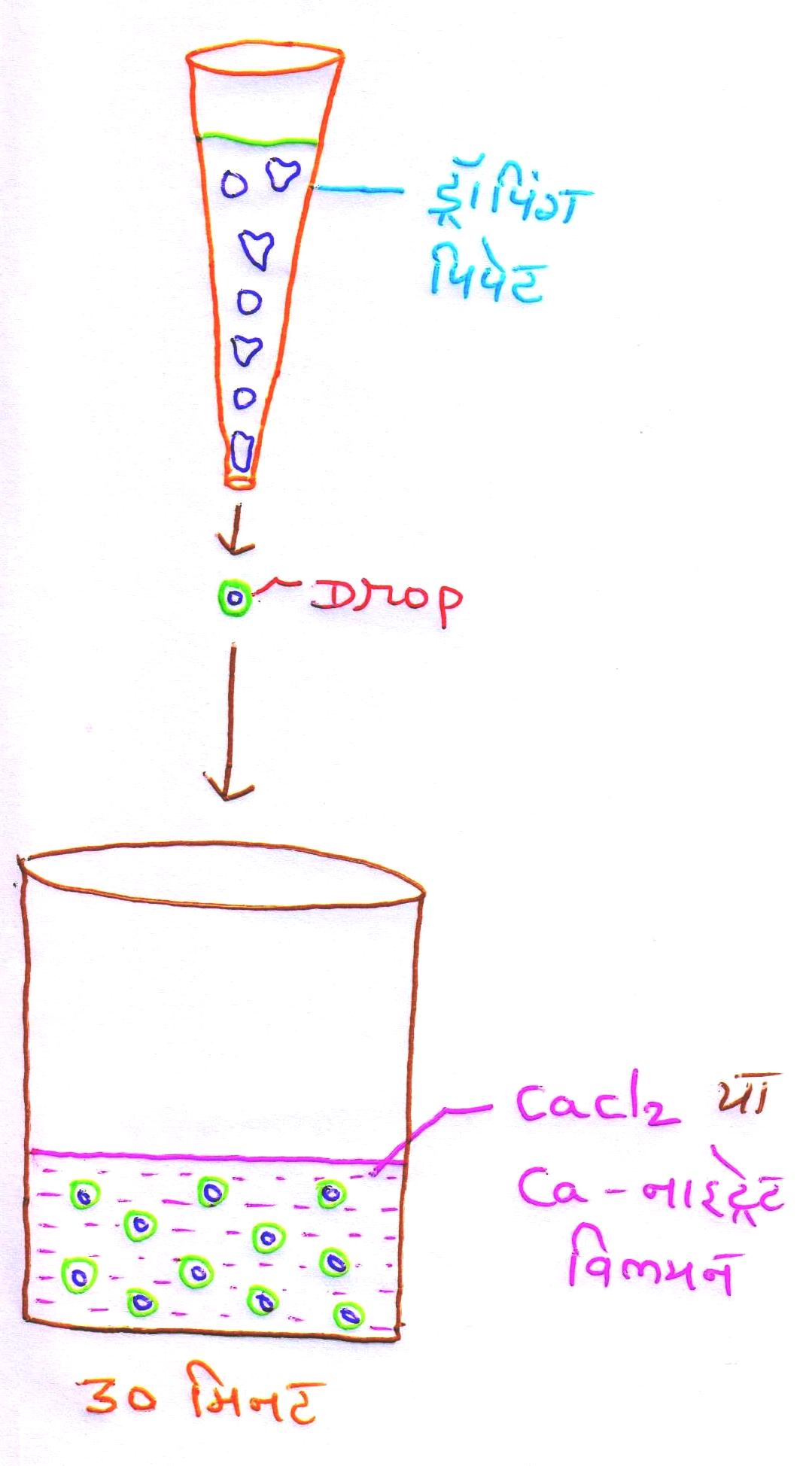

· 30 मिनट के इस समय में सोडियम आयनों को केल्सियम आयनों के द्वारा विस्थापित कर दिया जाता है। इस प्रकार प्रत्येक भ्रूण के चारों ओर केल्सियम ऐल्जिनेट का आवरण बन जाता है। इस प्रकार 4 – 6 mm आकार के कायिक भ्रूण युक्त पारदर्शी मनके बन जाते हैं जिन्हें संश्लिष्ट बीज कहते हैं।
(During this time of 30 minutes, sodium ions are displaced by calcium ions. In this way, the layer of calcium alginate is formed around each embryo. In this way 4 to 6 mm transparent bead contain embryonic embryos are formed which are called synthetic seeds.)


· अब इस विलयन को नायलॉन की छलनी छानते हैं जिससे संश्लिष्ट बीज पृथक हो जाते हैं।
(Now filter this solution through a nylon sieve, which separates the synthetic seeds.)


· अब इन बीजों को 10 मिनट के लिए विआयनीकृत जल में खंगालते हैं।
(Now these seeds are rinsed in deionized water for 10 minutes.)


· अब इन बीजों की 20 मिनट के लिए 121°C ताप पर ऑटोक्लेविंग करते हैं।
(Now autoclave these seeds at 121 ° C for 20 minutes.)
· अब 25 ± 1°C ताप पर 3 – 4 सप्ताहों के लिए अंधेरे में भंडारित करते हैं।
(Now store the synthetic seeds in dark for 3 - 4 weeks at 25 ± 1 ° C temperature.)
4. महत्व (Importance):-
i. पौधों में बीजों का निर्माण लैंगिक जनन की जटिल प्रक्रिया के द्वारा जनन अवस्था के अंत में होता है। एक पादप जनन अवस्था तक पहुँचने के लिए कम या अधिक समय ले सकता हैं। इसलिएपौधे से बीज प्राप्त करने लिए हमें जनन अवस्था के अंत तक प्रतीक्षा करनी पड़ती है। परन्तु कृत्रिम बीज एक महीने के अन्दर ही उपलब्ध हो जाते हैं। इस प्रकार हमें लंबे समय तक इंतजार करने की आवश्यकता नहीं पड़ती है।
(Seeds in plants are produced at the end of the reproductive stage through a complex process of sexual reproduction. A plant may take less or more time to reach reproductive stage. Therefore, we have to wait till the end of reproductive stage to get seeds from the plant. But synthetic seeds are available within a month. Thus we do not have to wait for long time.)
ii. पौधे वर्ष की एक विशेष मौसम में ही पुष्प व बीज उत्पन्न करते हैं। परन्तु कृत्रिम बीज उत्पादन समय व मौसम पर निर्भर नहीं करता है। वर्ष के किसी भी समय व मौसम में किसी भी पौधे के कृत्रिम बीज प्राप्त किए जा सकते हैं।
(Plants produce flowers and seeds in a particular season of the year. But synthetic seed production does not depend on time and season. Synthetic seeds of any plant can be obtained at any time and season of the year.)
iii. कुछ पौधों के बीजों में लम्बी प्रसुप्तावस्था पाये जाने के कारण इन पर कार्य देरी से हुआ है। कृत्रिम बीज़ बनाकर इस लम्बी अवधि को कम किया जा सकता है। कृत्रिम बीजों के उपयोग से एक पौधे के जीवन चक्र को छोटा किया जा सकता है।
(Due to the long dormancy found in the seeds of some plants, work on them has been delayed. This long duration can be reduced by producing synthetic seeds. The life cycle of a plant can be shortened by the use of synthetic seeds.)
iv. कायिक भ्रूणजनन लगभग सभी पादपों में संभव हैं। इसलिए कृत्रिम बीज़ का निर्माण सभी फसली पौधों में सफलतापूर्वक किया जा सकता है। कुछ उदाहरण हैं – गाजर, मक्का, कपास आदि।
(Somatic embryogenesis is possible in almost all plants. Therefore, synthetic seeds can be produced successfully in all crop plants. Some examples are carrots, maize, cotton etc.)
v. कृत्रिम बीजों का उपयोग बड़े पैमाने पर एकल संवर्धन उत्पन्न करने मिश्रित जीनप्रारूप पादप लगाने के लिए किया जाता है।
(Synthetic seeds are extensively used to plant mixed genotype plants to produce a single culture.)
vi. कृत्रिम बीज़ उत्पादन अर्धसूत्री रूप से अस्थायी व विशिष्ट जीनप्रारूपों को सुरक्षा प्रदान करता है।
(Synthetic seed production provides protection to meiotically unstable and specific genotypes.)
vii. कृत्रिम बीज में लाभकारी एडजुवैंट्स को बनाए रखने तथा प्रदान करने की क्षमता पायी जाती है जैसे –
(Synthetic seeds have the ability to maintain and provide beneficial adjuvants such as -)
Ø वृद्धि प्रेरित Rhizobacteria (Growth inducing Rhizobacteria)
Ø पादप पोषक (Plant Nutrients)
Ø वृद्धि नियंत्रक एजेंट्स (Growth Regulator agents)
Ø पेस्टिसाइड्स (Pesticides)
Viii. कृत्रिम बीज बीजचोल के निर्माण में भ्रूणपोष के योगदान के अध्ययन में सहायता करता है।
(Synthetic seeds help in the study of the contribution of embryos to the formation of seed coat.)
.png)
विभज्योतक संवर्धन (Meristem Culture):-
· परिभाषा (Definition):-
जब निर्जमित दशाओं में प्ररोह के 0.1 से 1 mm शीर्ष भाग को पृथक करके कर्तोतक के रूप में उपयोग करते हुए संवर्धित किया जाता है तो इसे प्ररोह शिखाग्र संवर्धन कहते हैं। शीर्ष भाग में 0.05 से 0.1 mm विभज्योतक पाया जाता है, इसलिए इसे विभज्योतक संवर्धन भी कहते हैं।
(When in sterilized conditions 0.1 to 1 mm tip of the shoot is removed and cultured using it as an explant, it is called shoot tip culture. The 0.05 to 0.1 mm meristem is found in the apex, so it is also called meristem culture.)

· विभज्योतक संवर्धन वायरस मुक्त पौधे प्राप्त करने के लिए किया किया जाता है। विभज्योतक में कोशिकाओं का विभेदन नहीं होता है। संवहन ऊतक अनुपस्थित होता है। विभज्योतक कोशिकाओं में तीव्र उपापचय क्रिया होती है। वायरस एक कोशिका से दूसरी कोशिका में गति नहीं कर सकता।
(The meristem culture is performed to obtain virus-free plants. Differentiation of cells does not occur in the meristem. Vascular tissue is absent. Meristem cells have a rapid metabolic activity. The virus cannot move from one cell to another.)
· विधि (Procedure):-
Ø एक स्वस्थ पौधे से तरुण टहनियों को काटते हैं। तरुण टहनी के 1cm शीर्ष भाग को काटकर अलग कर लेते हैं।
(Cut young twigs from a healthy plant. Now cut 1cm top part of the young twig.)

Ø 1-1cm लम्बे शीर्ष भागों के सतही निर्जमीकरण के लिए 1℅ सोडियम हाइपोक्लोराइट के विलयन में 10 मिनट तक ऊष्मायन करते हैं। अब इन शीर्ष भागों को 4 बार निर्जमित आसुत जल से धो लेते हैं ताकि सतह पर उपस्थित अतिरिक्त रसायन हट जाये।
(For surface sterilization we incubate 1–1cm long top parts in a solution of 1℅ sodium hypochlorite for 10 minutes . Now wash these top parts with sterilized distilled water 4 times so that the excess chemical present on the surface is removed.)

Ø अब प्रत्येक शीर्ष भाग को निर्जमित पेट्रीडिश में डालते हैं।
(Now put each top part in a sterilized patridish.)
Ø अब प्रत्येक शीर्ष भाग से बाहरी पत्तियों को हटा देते हैं जिससे प्ररोह शिखाग्र दिखाई देने लगता है।
(Now remove the outer leaves from each apex so that shoot tips make visible.)

Ø अब ब्लेड या चाकू की सहायता से 1mm लम्बे प्ररोह शिखाग्र को काट लेते हैं तथा इसे अगार माध्यम की सतह पर स्थानान्तरित कर देते हैं।
(Now 1 mm long shoot tips are cut with the help of a blade or knife, and transfer on to the surface of the agar medium.)

Ø अब इस संवर्धन का 25°C ताप व 16 घंटे प्रकाश काल पर ऊष्मायन करते हैं। जिससे कुछ दिनों में पहले प्ररोह तंत्र व बाद में मूल तंत्र विकसित हो जाता है। अब इन पौधों को गमलों में प्रतिस्थापित कर देते हैं।
(Now incubate this culture at 25 ° C temperature and 16 hours light period. As a result the shoot system is developed first and then the root system develops in a few days. Now establish these plants in pots.)


· Stages (अवस्थाएँ):- मुराशिग ने विभज्योतक संवर्धन में 3 अवस्थाओं के बारे में बताया है-
(Murashig has described 3 stages in the meristem culture-)
1. Stage – I:- इस अवस्था में संवर्धन स्थापित होता है जिसमें कर्तोतक से एकल या बहु प्ररोह विकसित होते हैं। इस अवस्था पर माध्यम में बाहर से साइटोकायनिन जैसे – BA, Kinetin व 2-iP की सप्लाई दी जाती है।
(Culture is established in this stage in which single or multiple shoots are developed from the explant. At this stage, the medium is supplemented with cytokine such as BA, Kinetin and 2-iP.)
2. Stage – II:- इस अवस्था का उद्देश्य प्रवर्धों का बहुगुणन होता है जिसके लिए कक्षस्थ प्ररोह प्रवर्धन होता है। यह उच्च आनुवंशिक स्थायित्व को बनाए रखता है।
(The purpose of this stage is multiplication of propagules for which the axillary shoot propagation occurs. It maintains high genetic stability.)
3. Stage – III:- इस अवस्था का उद्देश्य Stage – II में प्राप्त प्ररोह से अपस्थानिक जड़ों का निर्माण करना होता है। अपस्थानिक मूल निर्माण को प्रेरित करने के लिए माध्यम में बाहर से क्रमश: NAA, IBA, IAA, 2,4-D व अन्य ऑक्सिन हार्मोन्स की सप्लाई दी जाती है।
(The purpose of this stage is to develop the adventitious roots from the shoots obtained in Stage - II. The medium is supplemented externally with NAA, IBA, IAA, 2,4-D and other auxin hormones to induce adventitious root formation.)
· अनुप्रयोग (Applications):-
1. वायरस से मुक्ति (Virus Elimination):-
Ø पौधे सामान्यतया एक से अधिक प्रकार के वायरसों से संक्रमित होते हैं। जिनमें से कुछ अज्ञात होते हैं।
(Plants are usually infected with more than one type of viruses. Some of which are unknown.)
Ø विभज्योतक संवर्धन के द्वारा हम वायरस से संक्रमित पौधे से स्वस्थ वायरस मुक्त पौधों को विकसित कर सकते हैं। जैसे – आलू ।
(We can grow healthy and virus free plants from virus-infected plants through meristem culture. Like - Potatoes.)
2. सूक्ष्म प्रवर्धन (Micro propagation):-
Ø पौधे के किसी सूक्ष्म कायिक भाग से ऊतक संवर्धन तकनीक द्वारा सम्पूर्ण पौधे के निर्माण की प्रक्रिया को सूक्ष्म प्रवर्धन कहते हैं।
(The process of regeneration of the entire plant by tissue culture technique from any vegetative part of the plant is called micro propagation.)
Ø विभज्योतक संवर्धन एक प्रकार का सूक्ष्म प्रवर्धन ही है।
(Meristem culture is a kind of micro propagation.)
3. आनुवंशिक संसाधनों का भंडारण (Storage of Genetic Resources):-
Ø अनेक पौधे ऐसे बीज उत्पन्न करते हैं जो प्रकृति में उच्च विषमयुग्मनज होते हैं या दुर्दम्य (recalcitrant) होते हैं। इस प्रकार के बीजों को आनुवंशिक संसाधनों के भंडारण के लिए स्वीकृत नहीं किया जाता है।
(Many plants produce seeds that are highly heterozygous in nature or recalcitrant. These types of seeds are not approved for storage of genetic resources.)
Ø अत: इन पौधों से विभज्योतक को लेकर कृत्रिम रूप से संग्रहित किया जा सकता है।
(Hence, meristem taken from these plants can be stored artificially.)
4. संगरोध (Quarantine):-
Ø प्ररोह शिखाग्र संवर्धन या विभज्योतक संवर्धन से विकसित पौधे बिना जांच के अंतर्राष्ट्रीय विनिमय के लिए संगरोध प्राधिकरण के द्वारा आसानी से स्वीकृत कर लिया जाता है।
(Plants grown from shoot tip culture or meristem culture are easily approved by the quarantine authority for international exchange without testing.)
Ø इसलिए इस तकनीक के उपयोग से फसल सुधार प्रोग्राम में विश्व के किसी भी भाग से फसली पौधों को आसानी से आयात किया जा सकता है।
(Therefore, crop plants can be easily imported from any part of the world using this technique for crop improvement program.)
Comments
Post a Comment