2017 Solved Old Paper (BOT - 302) New OK
.png)

.png)


.png)
Cytoplasmic Inheritance:-> DNA is also found in chloroplasts and mitochondria in the cytoplasm. If a genetic trait is controlled by a gene present on this DNA, it is called cytoplasmic heredity.> Both cytoplasm and nucleus are inherited from the mother while only the nucleus is inherited from the father. >Thus cytoplasm passes to offspring only from mother. Hence it is also called maternal inheritance.> If such a genetic trait is found in the father, then it is not transmitted to the next generation.> If such a genetic trait is found in the mother, then it is 100% transmitted to the next generation.Characteristics:-i. Reciprocal Differences:- Cytoplasmic inheritance governs the characters with notable distinctions in reciprocal crosses in F₁.ii. Maternal Effects:- Distinct maternal effects are observed due to more contribution of cytoplasm to the zygote by a female parent than a male parent.iii. Mappability:- Chloroplast genes and mitochondrial genes have been mapped, which were very difficult to map. Chloroplast genes in Chlamydomonas and maize and mitochondrial genes in humans and yeast are some of the examples.iv. Non-Mendelian Segregation:- A typical segregation pattern not followed in cytoplasmic inheritance exhibits in the Mendelian inheritance.v. Somatic Segregation:- The characters, which are controlled by cytoplasmic genes, display segregation in somatic tissues. For example, segregation in somatic tissues like leaf variegation.vi. Governed by plasma genes:- Chloroplast or mitochondria DNA governs or manages Cytoplasmic inheritance.Significance:-> Cytoplasmic inheritance helps determine the significance of cytoplasmic organelles in the passing on of characteristics in several organisms.> Cytoplasmic inheritance helped map the chloroplast genome and mitochondrial genome in many species, such as humans, yeasts, maize, etc.> Cytoplasmic male sterility has developed in crops like maize, cotton, pearl millet, etc. It has promoted the production of hybrid seeds.> The role of mitochondria is gaining importance in heterosis, as heterosis results in vigorous growth of plants, which ultimately provides a higher yield of crops.> The mutation leads to the generation of new variants of characteristics. In cytoplasmic inheritance, these mutations are observed in chloroplast and mitochondrial DNA.Example:-Plastid inheritance:- i. Mirabilis jalapa:- Leaf colour - green, white and variegatedii. Iojap in Maize - Soap phenotype. Leaf colour - Green, white, stripedMitochondrial inheritance:-i. CMS (Cytoplasimc Male Sterility):- Maize, Cotton, Sorghum, Pearl milletii. Pokiness in Neurospora:- Two strains - wild (normal growth) and poky (slow growth)iii. Petite in yeast:- Two strains - wild (normal size) and petite (very small size)
साइटोप्लाज्मिक वंशागति:-कोशिका द्रव्य में स्थित क्लोरोप्लास्ट और माइटोकॉन्ड्रिया में भी डीएनए पाया जाता है । यदि कोई आनुवंशिक लक्षण इस डीएनए पर मौजूद जीन द्वारा नियंत्रित होता है, तो इसे कोशिका द्रव्य संबंधी आनुवंशिकता कहा जाता है। माता से कोशिका द्रव्य और केंद्रक दोनों विरासत में मिलते हैं, जबकि पिता से केवल केंद्रक ही विरासत में मिलता है ।
इस प्रकार, कोशिका द्रव्य संतान को केवल माता से ही प्राप्त होता है। इसलिए इसे मातृवंशीय विरासत भी कहा जाता है।यदि ऐसा आनुवंशिक लक्षण पिता में पाया जाता है, तो यह अगली पीढ़ी में स्थानांतरित नहीं होता है।यदि ऐसा आनुवंशिक लक्षण मां में पाया जाता है, तो यह अगली पीढ़ी में 100% स्थानांतरित हो जाता है।विशेषताएँ:-i. पारस्परिक अंतर:- F₁ में पारस्परिक संकरणों में उल्लेखनीय भेदों के साथ, कोशिका प्लाज्मिक वंशागति लक्षणों को नियंत्रित करती है।ii. मातृ प्रभाव:- युग्मनज में नर जनक की तुलना में मादा जनक द्वारा साइटोप्लाज्म के अधिक योगदान के कारण विशिष्ट मातृ प्रभाव देखे जाते हैं।iii. मानचित्रण क्षमता:- क्लोरोप्लास्ट जीन और माइटोकॉन्ड्रियल जीन का मानचित्रण किया गया है, जिनका मानचित्रण करना पहले बहुत कठिन था। क्लैमाइडोमोनास और मक्का में पाए जाने वाले क्लोरोप्लास्ट जीन और मनुष्यों और खमीर में पाए जाने वाले माइटोकॉन्ड्रियल जीन इसके कुछ उदाहरण हैं।iv. गैर-मेंडेलियन पृथक्करण:- एक विशिष्ट पृथक्करण पैटर्न जो साइटोप्लाज्मिक वंशागति में नहीं देखा जाता है, वह मेंडेलियन वंशागति में प्रदर्शित होता है। v. कायिक पृथक्करण:- वे लक्षण जो कोशिका द्रव्य के जीनों द्वारा नियंत्रित होते हैं, कायिक ऊतकों में पृथक्करण प्रदर्शित करते हैं। उदाहरण के लिए, पत्ती के रंग में विभिन्नता जैसे कायिक ऊतकों में पृथक्करण। vi. प्लाज्मा जीन द्वारा नियंत्रित:- क्लोरोप्लास्ट या माइटोकॉन्ड्रिया डीएनए साइटोप्लाज्मिक वंशानुक्रम को नियंत्रित या प्रबंधित करता है।महत्व:-> साइटोप्लाज्मिक वंशागति कई जीवों में लक्षणों के हस्तांतरण में साइटोप्लाज्मिक अंगों के महत्व को निर्धारित करने में मदद करती है।साइटोप्लाज्मिक वंशागति ने मनुष्यों, खमीर, मक्का आदि जैसी कई प्रजातियों में क्लोरोप्लास्ट जीनोम और माइटोकॉन्ड्रियल जीनोम का मानचित्रण करने में मदद की।मक्का, कपास, बाजरा आदि फसलों में कोशिका प्लाज्मिक नर बंध्यता विकसित हो गई है। इसने संकर बीजों के उत्पादन को बढ़ावा दिया है।हेटेरोसिस में माइटोकॉन्ड्रिया की भूमिका महत्वपूर्ण होती जा रही है, क्योंकि हेटेरोसिस के परिणामस्वरूप पौधों की जोरदार वृद्धि होती है, जिससे अंततः फसलों की अधिक पैदावार प्राप्त होती है।उत्परिवर्तन से लक्षणों के नए प्रकारों का निर्माण होता है। कोशिका प्लाज्मिक वंशागति में, ये उत्परिवर्तन क्लोरोप्लास्ट और माइटोकॉन्ड्रियल डीएनए में देखे जाते हैं।उदाहरण:-प्लास्टिड वंशागति:- i. मिराबिलिस जलापा:- पत्तों का रंग - हरा, सफेद और चित्तीदारii. मक्का में इओजाप - साबुन जैसा फेनोटाइप। पत्ती का रंग - हरा, सफेद, धारीदारमाइटोकॉन्ड्रियल वंशागति:-i. सीएमएस (साइटोप्लाज्मिक नर बंध्यता):- मक्का, कपास, ज्वार, बाजराii. न्यूरोस्पोरा में पोकीनेस:- दो प्रकार - जंगली (सामान्य वृद्धि) और पोकी (धीमी वृद्धि)iii. पेटिट यीस्ट:- दो प्रकार - जंगली (सामान्य आकार) और पेटिट (बहुत छोटा आकार)

बहुगुणिता (Polyploidy):-
किसी जीव में सामान्य गुणसूत्र संख्या का विचलित हो जाना ही बहुगुणिता कहलाती है। यह 2 प्रकार की होती है –
(Deviation from the normal chromosome numbers in an organism is called polyploidy. It is of 2 types -)
1. असत्यगुणिता (Aneuploidy)
2. सत्यगुणिता (Euploidy)
1. असत्यगुणिता (Aneuploidy):-
• परिभाषा (Definition):-
सामान्यतया जीव की प्रत्येक कायिक कोशिका के जीनोम में गुणसूत्रों की संख्या निश्चित होती है। यदि जीनोम में 1 या 2 गुणसूत्रों की संख्या में कमी या वृद्धि हो जाये तो इसे असत्यगुणिता कहते हैं। यह अधिकतर जंतुओं में ही पायी जाती है। पादपों में बहुत कम देखने को मिलती है।
(Generally, the number of chromosomes in the genome of each somatic cell of an organism is fixed. If there is a decrease or increase in the number of 1 or 2 chromosomes in the genome, it is called as aneuploidy. It is found mostly in animals. It is rarely seen in plants.)
• अनेक प्रकार हैं (Many types):-
i. Nullysomy = (2n – 2)
ii. Monosomy = (2n – 1)
iii. Double monosomy = (2n – 1 – 1)
iv. Trisomy = (2n + 1)
v. Double trisomy = (2n + 1 + 1)
vi. Tetrasomy = (2n + 2)
2. सत्यगुणिता (Euploidy):-
• परिभाषा (Definition):- सामान्यतया जीव की प्रत्येक कायिक कोशिका में जीनोम की 2 प्रतियाँ उपस्थित होती हैं। जब जीव की कायिक कोशिकाओं में जीनोम की 2 से अधिक प्रतियाँ पायी जाती हैं तो इसे सत्यगुणिता कहते हैं। यह केवल पौधों में पायी जाती है। जंतुओं में इसका पूर्णत: अभाव होता है।
(Normally, each somatic cell of organism has 2 copies of the genome. When more than 2 copies of the genome are found in the somatic cells of organism, it is called euploidy. It is found only in plants. It is completely absent in animals.)
• 2 प्रकार हैं (2 types):-
i. स्वबहुगुणिता (Autopolyploidy)
ii. परबहुगुणिता (Allopolyploidy)
i. स्वबहुगुणिता (Autopolyploidy):-
• परिभाषा (Definition):-
जब जीव की सभी कायिक कोशिकाओं में उपस्थित जीनोम की प्रतियाँ एक ही जाति की होती हैं तो इसे स्वबहुगुणिता कहते हैं।
(When copies of the genome present in all the somatic cells of an organism belong to the same species, it is called autopolyploidy.)
• उदाहरण (Examples):-
त्रिगुणित (Triploid) = 3x
चतुर्गुणित (Tetraploid) = 4x
पंचगुणित (Pentaploid) = 5x
षटगुणित (Hexaploid) = 6x
ii. परबहुगुणिता (Allopolyploidy):-
• परिभाषा (Definition):-
जब जीव की सभी कायिक कोशिकाओं में उपस्थित जीनोम की प्रतियाँ एक से अधिक जातियों से आती हैं तो इसे परबहुगुणिता कहते हैं।
(When copies of the genome present in all somatic cells of an organism come from more than one species, it is called allopolyploidy.)
• उदाहरण (Examples):-
चतुर्गुणित (Tetraploid) = 2x1 + 2x2
षटगुणित (Hexaploid) = 2x1 + 2x2 + 2X3
स्वबहुगुणिता उत्पन्न होने के कारण (Reasons of producing autopolyploidy):-
• अनियमित अर्धसूत्री विभाजन के कारण 2n युग्मक उत्पन्न होते हैं।
(2n gametes are produced due to abnormal meiosis.)


• कोल्चिसीन रसायन के उपयोग से गुणसूत्रों का कृत्रिम रूप से द्विगुणन कर सकते हैं। यह रसायन कोशिका विभाजन के दौरान तर्कु तंतुओं के निर्माण को रोक देता है।
(Artificial duplication of chromosomes can be achieved using colchicine chemical. This chemical prevents the formation of spindle fibers during cell division.)

• कृत्रिम रूप से स्वबहुगुणिता उत्पन्न करने के लिए बीज या पादपक या प्ररोह शिखाग्र को 1% ताजा कोल्चीसीन विलयन में 1 से 10 दिनों के लिए भिगोकर रखते हैं।
(To produce autopolyploidy artificially, soak the seed or plantlet or shoot apex in 1% fresh colchicine solution for 1 to 10 days.)


बहुगुणिता का प्रभाव (Effects of Polyploidy):-
i. महाकायता (Gigantism):- पौधे के आकार व ओज में वृद्धि हो जाती है।
(The size and vigour of the plant increases.)
ii. पत्तियों, पुष्पों, फलों, बीजों आदि के आकार में वृद्धि और संख्या में कमी हो जाती है।
(The size of leaves, flowers, fruits, seeds etc. increases and their number decreases.)
iii. बड़े रंध्र व कोशिकाएं (Larger stomata and cells)
iv. बड़े परागकण (Larger pollens)
v. कम उर्वरता (Low fertility)
vi. कम वृद्धि दर (Low growth rate)
vii. देरी से पुष्पन (late flowering)
viii. जल की मात्रा बढ़ने से उच्च ताजा भार व शुष्क भार कम
(Higher fresh weight and lower dry mass due to increase in water content)
ix. उपयुक्त गुणिता स्तर एक जाति से दूसरी जाति में बदलता रहता है।
(The suitable ploidy level varies from one species to another.)
उदाहरण (Examples):-
चुकंदर (Sugar beet) = 3x
टीमोथी घास (Timothy grass) = 8x – 10x
पादप प्रजनन व जैव विकास में उपयोग (Role in evolution and plant breeding):-
• स्वत्रिगुणित पौधे (Autotriploid Plants):-
i. केला (Banana):- इसके फल बीज रहित होते हैं।
(Its fruits are seedless.)
ii. तरबूज (Water melon):- यह जापान में होता है। इसके फल भी बीज रहित होते हैं।
(It is found in Japan. Its fruits are also seedless.)
iii. चुकंदर (Sugar beet):- यह जापान व यूरोप में होती है। इसकी जड़े बड़ी होती हैं जो अधिक शर्करा उत्पादन करती हैं।
(It is found in Japan and Europe. Its roots are bigger which produces more sugar.)
iv. चाय (Tea):- इसकी TV – 29 किस्म सूखा रोधी व अधिक उपज देने वाली होती है।
(Its TV-29 variety is drought resistant and high yielding.)
• स्वचतुर्गुणित पौधे (Autotetraploid Plants):-
i. मक्का (Maize):- इसमें 43% अधिक विटामिन होता है।
(It contains 43% more vitamins.)
ii. क्लोवर व बरसीम (Clover and Barseem):- इनकी चारा उपज अधिक होती है। Pusa Giant Barseem भारत में एक प्रसिद्ध किस्म है।
(Their fodder yield is high. Pusa Giant Barseem is a famous variety in India.)
iii. राई (Rye):- इसकी दो किस्मों Double steel व Tetrapetkus की उपज अधिक होती है।
(Its two varieties Double steel and Tetrapetkus have high yield.)
iv. Hyoscymus niger:- इसकी HMT – 1 किस्म का 15% जैवभार अधिक होता है और इससे 36% अधिक औषधि प्राप्त होती है।
(Its HMT-1 variety has 15% more biomass and provides 36% more medicine.)
v. Vetiveria zizanoides:- इसकी vetiver किस्म से 11% अधिक सुगंधित तेल प्राप्त होता है।
(Its vetiver variety yields 11% more fragrant oil.)
• परचतुर्गुणित पौधे (Allotetraploid Plants):-
i. कपास (Cotton):- Gossypium hirsutum
ii. सरसों (Mustard):-
Ø Brassica juncea (AABB)
Ø Brassica napus (AACC)
Ø Brassica carinata (BBCC)
• परषटगुणित पौधे (Allohexaploid Plants):-
i. गेहूँ (Wheat):- Triticum aestivum (AABBDD)
.png)

.png)
.png)
.png)
3. प्रतीप संकरण विधि (Back Cross Method):-
• परिभाषा:- जब F1 पीढ़ी के पौधों का किसी एक जनक से बार बार प्रतीप संकरण कराया जाता है, तो इस विधि को प्रतीप संकरण कहते हैं। इसके फलस्वरूप नई किस्म का जीन प्रारूप उस जनक के लगभग एक समान हो जाता है।
(When F1 generation plants are repeatedly crossed with one parent plants, this method is called backcross method. As a result, the genotype of the new variety is almost identical to that of the parent.)
• आवर्ती जनक या आदाता जनक (Recurrent Parent or Recipient Parent):- जिस जनक के साथ F1 पीढ़ी का बार बार प्रतीप संकरण कराया जाता है। यह उत्कृष्ट जनक होता है। इसमें केवल एक विशिष्ट लक्षण की कमी होती है।
(The parent with whom the F1 generation plant is repeatedly crossed up. It is an superior parent. It lacks only one specific trait.)
• अनावर्ती जनक या दाता जनक (Non - recurrent Parent or Donor Parent):- अन्य जनक। यह उत्कृष्ट या निकृष्ट हो सकता है। जिस लक्षण की आदाता जनक में कमी होती है, वह इस जनक में उच्च परिमाण में उपस्थित होता है।
जैसे जैसे प्रतीप संकरण होता जाता है वैसे वैसे आवर्ती जनक के जीनों की आवृति बढ़ती जाती है। जैसा कि नीचे flowchart व सारणी में प्रदर्शित किया गया है।
(Other parent. It can be superior or inferior. The trait which is deficient in the recipient parent is present in a higher proportion in this parent.
As the back cross progresses, the frequency of the genes of the recurring parent increases. As shown in the flowchart and table below.)


व्यापीकृत रूपरेखा (Generalized Outline):-

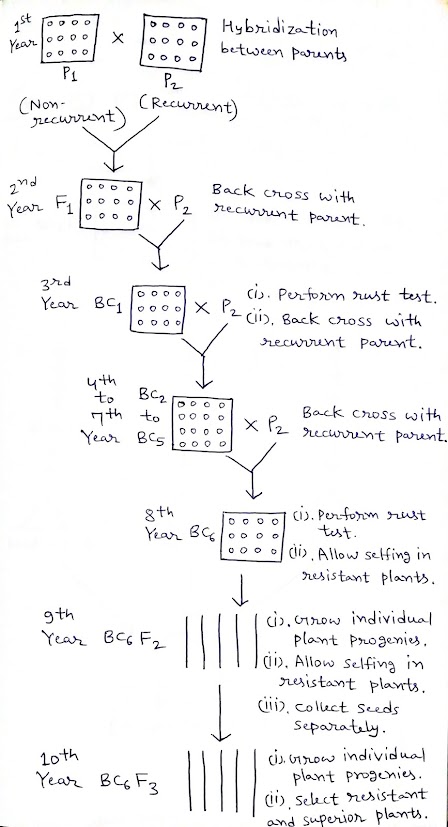

.png)
हिटेरोसिस (Heterosis):-:
• हिटेरोसिस शब्द सबसे पहले Shull ने 1914 में दिया था।
(The term Heterosis was first coined by Shull in 1914.)
• परिभाषा (Definition):- जब F1 संकर कई लक्षणों जैसे सामान्य ओज, अनुकूलन, उपज आदि में अपने दोनों जनकों से उत्कृष्ट होता है तो इसे हिटेरोसिस या संकर ओज कहते हैं।
(When the F1 hybrid is superior from both its parents in many traits such as normal vigor, adaptation, yield etc., it is called heterosis or hybrid vigor.)
• हिटेरोसिस के 2 प्रायवाची शब्द हैं:-
(There are 2 synonyms of Heterosis: -)
i. संकर ओज (Hybrid Vigor)
ii. बाह्यप्रजनन अतिवर्धन (Out breeding Enhancement)
संकरों के प्रकार (Types of Hybrids):-
1. एकल क्रॉस संकर (Single Cross Hybrids):-
A x B
2. तीन वे संकर (Three Way Hybrid):-
(A x B) x R
3. द्विक्रॉस संकर (Double Cross Hybrid):-
(A x B) x (R x S)
हिटेरोसिस का आनुवांशिक आधार (Genetic Basis of Heterosis):- हिटेरोसिस को तीन परिकल्पनाओं के द्वारा समझाया जा सकता है-
(Heterosis can be explained by three hypotheses-)
1. प्रभाविता परिकल्पना (Dominance Hypothesis)
2. अतिप्रभाविता परिकल्पना (Over dominance Hypothesis)
3. प्रबलता परिकल्पना (Epistasis Hypothesis)
1. प्रभाविता परिकल्पना (Dominance Hypothesis):-
· यह परिकल्पना Davenport के द्वारा 1908 में दी गयी थी तथा 1910 में Bruce के द्वारा इसका समर्थन किया गया था।
(This hypothesis was given by Davenport in 1908 and supported by Bruce in 1910.)
· इस परिकल्पना के अनुसार हिटेरोसिस प्रभावी युग्म विकल्पी की अप्रभावी युग्म विकल्पी पर श्रेष्ठता के कारण विकसित होती है।
(According to this hypothesis, heterosis develops due to the superiority of dominant allele over recessive allele.)
AA = Aa > aa
BB = Bb > bb
प्रत्येक जनक के द्वारा जितने अधिक संख्या में प्रभावी जीनों का योगदान दिया जाता है, हिटेरोसिस उतनी ही अधिक होती है।
(The higher the number of dominant genes contributed by each parent, the higher is the heterosis.)


उदाहरण (Example):-


2. अतिप्रभाविता परिकल्पना (Overdominance Hypothesis):-
· यह परिकल्पना East व Shull के द्वारा 1908 में स्वतंत्र रूप से दी गयी थी।
(This hypothesis was independently given in 1908 by East and Shull.)
· इस परिकल्पना के अनुसार हिटेरोसिस विषमयुग्मनजता के कारण विकसित होती है। विषमयुग्मनज अवस्था में प्रभावी युग्म विकल्पी समयुग्मनज अवस्था की तुलना में अति अभिव्यक्ति प्रदर्शित करता है।
(According to this hypothesis, heterosis develops due to heterozygosity. In the heterozygous state, the dominant allele exhibits over-expression compared to the homozygous state.)
AA < Aa >> aa
BB < Bb >> bb
F1 संकर में विषमयुग्मनज जोड़ों की संख्या जितनी अधिक होती है, हिटेरोसिस भी उतनी ही अधिक होती है।
(The higher the number of heterozygous pairs in F1 hybrids, the higher the heterosis.)


उदाहरण (Example):-


3. प्रबलता परिकल्पना (Epistasis Hypothesis):-
· यह परिकल्पना 1952 में Gowen के द्वारा दी गयी थी।
(This hypothesis was given by Gowen in 1952.)
· इस परिकल्पना के अनुसार हिटेरोसिस अयुग्म विकल्पीय जीनों के मध्य अनुकूल संक्रिया के कारण विकसित होती है।
(According to this hypothesis, heterosis develops due to favorable interactions between non-allelic genes.)
AA > Aa > aa
BB > Bb > bb
हिटेरोसिस का आंकलन (Estimation of Heterosis):- हिटेरोसिस का आंकलन 3 प्रकार से किया जा सकता है:-
(Heterosis can be estimated in 3 ways: -)
1. औसत हिटेरोसिस (Average Heterosis)
2. हिटेरोबेल्टिओसिस (Heterobeltiosis)
3. उपयोगी हिटेरोसिस (Useful Heterosis)
1. औसत हिटेरोसिस (Average Heterosis):-
जब F1 संकर मध्य जनक से उत्कृष्ट होता है तो इसे औसत हिटेरोसिस कहते हैं।
(When the F1 hybrid is superior than the mid parent, it is called average heterosis.)

AH = औसत हिटेरोसिस (Average Heterosis)
F1 = F1 संकर की औसत उपज (Average Yield of F1 Hybrid)
MP = दोनों जनकों की उपज का औसत (Average of Yields of both the parents)
2. हिटेरोबेल्टिओसिस (Heterobeltiosis):-
जब F1 संकर उत्कृष्ट जनक से उत्कृष्ट होता है तो इसे हिटेरोबेल्टिओसिस कहते हैं।
(When the F1 hybrid is superior than the superior parent, it is called heterobeltiosis.)

HB = हिटेरोबेल्टिओसिस (Heterobeltiosis)
F1 = F1 संकर की औसत उपज (Average Yield of F1 Hybrid)
BP = उत्कृष्ट जनक की औसत उपज (Average Yield of superior parent)
3. उपयोगी हिटेरोसिस (Useful Heterosis):-
· यह शब्द Meredith व Bridge के द्वारा 1972 में दिया गया था।
(The term was coined by Meredith and Bridge in 1972.)
· इसके 2 प्रायवाची शब्द भी हैं:-
(This word also have 2 synonyms: -)
i. आर्थिक हिटेरोसिस (Economic Heterosis)
ii. मानक हिटेरोसिस (Standard Heterosis)
· इस प्रकार की हिटेरोसिस का पादप प्रजनन में प्रायोगिक उपयोग है।
(This type of heterosis has practical use in plant breeding.)
· परिभाषा (Definition):- जब F1 संकर उन्नत किस्म से उत्कृष्ट होता है तो इसे उपयोगी हिटेरोसिस कहते हैं।
(When the F1 hybrid is superior than the improved variety, it is called useful heterosis.)

UH = उपयोगी हिटेरोसिस (Useful Heterosis)
F1 = F1 संकर की औसत उपज (Average Yield of F1 Hybrid)
CV = उन्नत चैक किस्म की औसत उपज (Average Yield of improved Check Variety)
Luxuriance:- अंतरा जातीय संकरण कराने पर उत्पन्न F1 संकर जब अपने दोनों जनकों से उत्कृष्ट होता है तो इसे Luxuriance कहते हैं। F1 संकर अपने जनकों की तुलना में बहुत अधिक ओज व आकार प्रदर्शित करता है तथा यह आंशिक या पूर्ण रूप से बंध्य होता है।
(When the F1 hybrid, produced by interspecific hybridization, is superior than both of its parents, it is called Luxuriance. The F1 hybrid exhibits a much larger size and vigor than its parent and it is partially or completely sterile.)


हिटेरोसिस के अनुप्रयोग (Application of Heterosis):- हिटेरोसिस के उपयोग से अनेक फसलों में उन्नत संकर किस्में विकसित की गयी हैं।
(Improved hybrid varieties have been developed in many crops using heterosis.)
1. मक्का (Maize):- Ganga-1, Ganga-5, Ganga- 11
2. बाजरा (Bajra):- HB-3, BJ-104, MH-179
3. सूरजमुखी (Sunflower):- BSH-1, KBSH-1, KBSH-11
4. अरंडी (Castor):- GCH-2, GCH-3, GCH-4
5. अरहर (Pigeon pea):- ICPH-8
6. जूट (Jute):- Hybrid-C
7. बैंगन (Brinjal):- Vijay, Pusa Kranti
8. तरबूज (Water melon):- Pusa Sanyog
9. लगभग सभी फल वृक्ष (Almost all Fruit Trees)
अंत:प्रजनन ह्रास (Inbreeding Depression):-
• परिभाषा (Definition):-
परपरागित फसलों में जब बार बार स्वपरागण कराया जाता है तो उनकी ओज में कमी आ जाती है। इसे ही अंत: प्रजनन ह्रास कहते हैं।
(When selfing is done repeatedly in cross-pollinated crops, their vigor get reduced. This is called inbreeding depression.)
• निकटता से संबन्धित पौधों में क्रॉस के कारण यह उत्पन्न होती है।
(It is caused by crosses in closely related plants.)
• इस प्रक्रिया में विषमयुग्मनजता में कमी आती है तथा समयुग्मनजता बढ़ती जाती है।
(In this process, heterozygosity decreases and homozygosity increases.)
• यह प्रतिकूलित अप्रभावी जीनों के स्थिरीकरण के कारण होती है।
(This is caused by fixation of unfavorable recessive genes.)
.png)


.png)
.bmp)
.bmp)
.bmp)
.bmp)
.png)
.bmp)
.bmp)

Comments
Post a Comment